
South Korea 2025
Published 03/23/2026 in Scholar Travel Stipend
Written
by Angelina Calderón |
03/23/2026
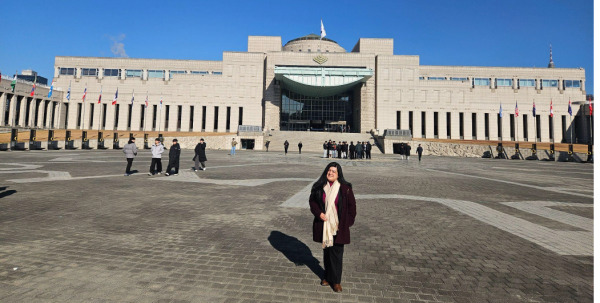
The opportunities to visit Asia with the Milken Scholar stipend have opened my eyes to new experiences and new perspectives. As I was preparing for my second Asia trip and the perspectives I would be learning about I was struck with an epiphany I had while in my first Asia trip.
Visiting the Củ Chi tunnels outside of Ho Chi Mihn City in Vietnam was an eye-opening experience. As an American, when I thought of the Vietnam War, I thought that a lot of people had died and I remembered learning about the protests against the war. However, when we visited the Củ Chi tunnels, I learned the perspective of the Vietnamese people who celebrated that even without tanks, they were able to outsmart the American soldiers. They celebrated the victory over the American army. I wondered if I would encounter something similar in The War Memorial of Korea.
The difference is that for South Korea, the United States became an ally. While the museum still celebrated the South’s ability to fight an enemy that had better training, mightier military weapons, and almost obliterated them, they also celebrated the US intervention in the war. I learned that Seoul fell in 3 days because the South Koreans did not have the same type of weapons or preparations as the northern army did. Some of the current political landscape still has roots to that faithful day in 1950 when North Korea invaded the South with tanks supported by Soviet Union. When the United States and eventually the United Nations sent ground troops During my visit, I saw firsthand the gratitude of the Korean people for American support. Nonetheless, when China supported the North Korean forces, it was clear that the war could not be won. Having learned from the Vietnam War, when it was obvious there was a stalemate, they opted for a truce.

Decades after the Armistice Agreement of 1953, the South Korean government still needs the American government’s support and alliance to face the North. So when President Trump conducted an Asia tour in October 2025, he was honored with a “high honor” ceremony at Gyeongju National Museum in Gyeongju. NPR reported “President Lee Jae Myung gave Trump a replica of a golden crown significant to Korea's history. Trump also got a gold medal and was awarded Korea's highest civilian honor.” [1] It was important for the government officials to honor the American leader for diplomacy. The Korea Daily highlighted that the visit was another opportunity to finalize the trade deal to lower the “reciprocal tariffs on Korean imports from 25 percent to 15 percent in exchange for the large-scale investment pledge.” [2]

That’s the perspective of the government and the one highlighted in the media. However, for some Korean citizens, the perspective is different. When I spoke to young man named Jun, he shared somber concerns about the effect of the US policies on the Korean people. He shared how sad it was to see video and hear the stories of the Korean immigrants who were detained in Georgia at a Hyundai factory in September 2025. In an extreme show of force—and not a lot understanding of international politics—Immigration and Customs Enforcement agents raided the plant and arrested over 300 workers, claiming visa irregularities. The Donga-ilbo Newspaper concluded “domestic and foreign policy priorities under the administration, including countering China and tightening illegal immigration enforcement, can quickly create risks for the South Korea-U.S. alliance.” [3]
While Jun’s concerns were for the well-being of the Korean workers, the news media were also concerned about a breakdown of the relationship between the US and Korean governments. The incident jeopardized the strong positive relationship between both countries. The US Department of State must have had to repair the diplomatic relationship so that President Trump would be well received the following month.
Likewise, Jun was concerned about the effect of tariffs and trade agreements on the price of gas. While the federal administration was touting the tariffs as a win for America, everyday people in Korea were facing the high costs of those tariffs. The instability in trade negotiations made it so that one liter of gas was almost $2, much higher than they were used to paying. Again the views of the government differed from the perspective of people around the world.
 Jun also discussed the differences in Korean political class functions compared to the American. He explained that President Yoon’s martial law declaration in December 2024 sparked protests because many South Koreans remember the last time martial law was imposed in 1980 and the many deaths it caused. President Yoon was promptly removed from office, impeached in Constitutional Court and is still facing criminal charges for his actions.[4] When he compared this to the American President who was impeached twice [5], and was still re-elected, he saw a stark difference.
Almost 2 months after my trip, I’m still marveling at everything I saw, heard, ate and experienced in Japan and Korea. In Japan, I saw the cleanliness of Tokyo, heard the quiet train rides, ate the most exquisite sushi I’ve ever tasted and experienced high-tech solutions that were available as a norm. As a tourist, I marveled at the societal and technological advances that the Japanese people have been able to achieve.
When I visited Seoul, Dr. Mary Park reminded me that for Korean people, Japan was the conquering nation who infl icted pain in the surrounding countries. While it’s been decades since Japan ruled Korea, there’s still some resentment. Marisol also noted that Japan’s advancements were probably related to the wealth and spoils it obtained as an Empire. Again, I was faced with contrasting perspectives of a tourist versus that of someone who lives in neighboring country with deep shared history.
This trip and this research project helped me understand that there are varied perspectives of a matter: the one extolled by the governments, the one reported in the news media, the ones memorialized in museums and the experiences of those who have to live with the consequences of the governments’ actions. To create a better world, one must consider each one of these perspectives, because excluding any one of them can mean an incomplete understanding of a matter. While governments and media often have to take on a delicate dance for diplomacy’ sake, that façade can come crumbling down when citizens talk about the day-to-day realities of their lives. Thank you again for the opportunity to learn more about the South Korean perspectives of the historical and current political relationship with the United States.

References
1. Shivaram, D. (2025, October 31). Five key takeaways from Trump’s week in Asia. NPR.
https://www.npr.org/2025/10/31/nx-s1-5591999/five-key-takeaways-from-trumps-week-in-asia/
2. The Korea Daily Digital Team. (2025, October 29). Korea, U.S. finalize bilateral trade deal, agree on $350 billion
investment details. Korea Daily US.
https://www.koreadailyus.com/korea-u-s-finalize-bilateral-trade-deal-agree-on-350-billion-investment-details/
3. The DONG-A ILBO. (2025, September 12). South Korean detentions highlight U.S. alliance risks. Donga.
https://www.donga.com/en/article/all/20250912/5843572/1/
4. BBC News. (2026, January 16). South Korea’s impeached president found guilty in first of four trials: What you
need to know. BBC News. https://www.bbc.com/news/articles/cy9y039ygdro/
5. The DONG-A ILBO. (2021, February 15). Trump hints at remaining in politics after acquittal. Donga.
https://www.donga.com/en/article/all/20210215/2437270/1/
Author(s):
