
Learning Beyond the Classroom: Public Wellness, Education, and Community Spaces in Seoul, South Korea
Published 05/26/2026 in Scholar Travel Stipend
Written
by Karen Garcia |
05/26/2026
While walking within the crowds of Seoul, everything moves quickly. Trains arrive in minutes and people sprint to their next destination, all while historic buildings lie next to modern glass towers. At first, the city’s pace seems to reflect efficiency and productivity. Coming from New York City, I first felt a sense of familiarity in the city’s personality. But during my time in Seoul, I became most interested in the places where the city asked people to slow down: a public library at the center of the mall, a restored stream sprawling at the center of downtown, and shared spaces where learning, wellness, and community intersect.
Through visits to Starfield Library, Mapo Lifelong Learning Center, and Cheonggyecheon Stream, I examined how public spaces in Seoul support education, reflection, environmental awareness, and well-being. I began
to wonder: how can a city educate and care for its people beyond the traditional classroom?
Starfield Library, 별마당도서관
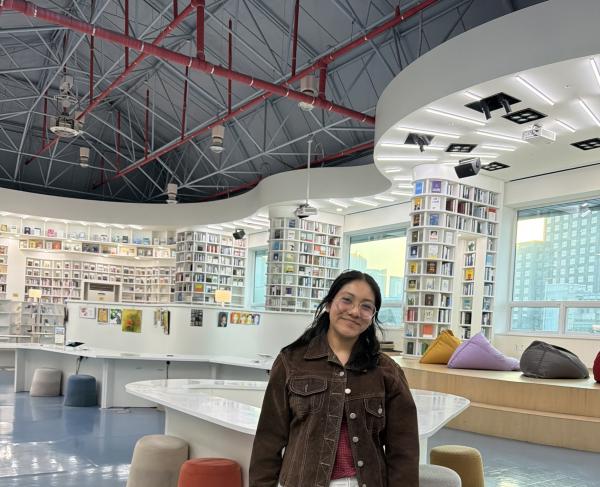
Starfield Library is striking because it appears where one might least expect it. Located inside COEX mall, it sits in the middle of a space of shopping, movement, and commerce. Yet, the library transforms that environment. Opened in 2017, Starfield Library houses more than 50,000 books and serves as a venue for cultural events, musical concerts, special lectures, and book tours [1]. Its design was led by Shinsegae Property with the intention of combining books, culture and arts in a space accessible to local residents, workers, and visitors [2]. With its 43-foot-tall shelves, open seating, and visible reading areas, the library creates the feeling that knowledge does not belong behind closed doors, but in the center of public life. While I often associate learning with classrooms, laboratories, and university libraries, spaces that feel structured and sometimes even exclusive, Starfield Library offers a different model. It suggests education can be informal, voluntary, and communal. What struck me most was the sense of trust built into the space. Many of the books have been donated, and while visitors are encouraged to browse them freely, the books cannot be checked out. Instead, the system relies on people returning them to their original locations [1]. This expectation of shared responsibility made the library feel not only like a place of reading, also like a civic space. In this way, the library reflected a broader culture of learning and self-improvement. Its very presence in a public commercial space made reading, curiosity, and intellectual life visible and inspirational. Starfield Library demonstrated how access to knowledge can be embedded into daily life, creating opportunities for reflection and growth outside traditional academic settings.

Mapo Lifelong Learning Center, 마포평생학습관
Another space that deepened my understanding of Seoul’s educational culture was Mapo Lifelong Learning Center. Located near Hongdae, an area often associated with youth culture, universities, art, music, and nightlife, the center offered an expression of the neighborhood’s energy. Unlike Starfield Library, which presents learning through a public cultural space, Mapo Lifelong Learning Center felt more like an educational ecosystem. Run by the Seoul Metropolitan Office of Education, it is a combination of a public library, community center, a cultural venue, and a learning institution. Its floors include general reading rooms, children’s and multilingual collections, study spaces, lecture rooms, a gallery, creative learning spaces, an auditorium and even wellness facilities such as a fitness center and swimming pool. What made this space special was the range of people it seemed designed to serve. The posters and programs reflected not only academic learning, but also cultural participation and community support. The event calendar posted by the elevator included programs such as senior digital finance education, reading clubs, and public classes. This showed me that lifelong learning in Seoul is not an abstract value, but something built into public infrastructure. At Mapo Lifelong Learning Center, education was not limited by age, profession, or school enrollment. It was presented as a continuing public resource, available to children, students, adults, seniors, families, and community members. This center also helped me see how closely education and wellness can be connected. The presence of study spaces, cultural programs, creative rooms, and physical wellness facilities within one public institution suggested a broader understanding of human development. Seoul’s public spaces were not only helping people learn, they were helping people
live more fully.

Cheonggyecheon Stream, 청계천
Cheonggyecheon Stream offered a different kind of lesson. After moving through the density of Seoul’s streets, descending toward the stream felt like entering a stiller layer of the city. While the sounds of the city did not disappear completely, the sounds still softened. At the stream, I watched people move through the city differently. Some walked quickly, using the path as part of their commute, others chatted with their friends as they walked, and others sat near the water, taking a break from above. People moved through a space designed not for speed, but for pause. This contrast revealed the stream’s importance as more than a scenic landmark. It functioned as wellness infrastructure, offering movement and rest within the busiest parts of Seoul.
The stream is also a reminder that public wellness often requires restoration. Cheonggyecheon was not simply preserved, it was recovered and reimagined as a part of Seoul’s urban landscape. Historically, Cheonggyecheon was an approximately 11 kilometer stream formed by tributaries from the mountains surrounding Seoul, flowing through the center of the city before joining the Han Rover. When Seoul became the capital of the Joseon Dynasty, the stream marked a border between the northern and southern parts of the city, and served as a place for gathering and seasonal activities. It also functioned as part of the city’s drainage and sewage infrastructure, and because of flooding and sanitation concerns, it had to be frequently maintained [3].
After the Korean War, informal settlements grew along the stream and the surrounding areas became associated with poverty, pollution, and overcrowding. Beginning in 1958, Seoul covered it with concrete, and by 1977 much of the stream was buried beneath pavement and elevated highway, turning it into a symbol of rapid industrialization [3]. The restoration project, which began in 2003 and was completed in 2005, therefore represented more than the return of water to the city. It involved demolishing elevated highways, removing decades-old concrete pavement, and restoring about 5.8 kilometers of stream in central Seoul [3]. Professor Noh Soo Hong from Yonsei University describes the project as a “paradigm shift” in Seoul’s urban environment, with goals that included restoring cultural and historical heritage, bringing an ecosystem back into the city [4]. What makes Cheonggyecheon particularly interesting to me is that its restoration project was not a simple return to untouched nature. Jeon and Kang describe the project as a negotiation between nature, technology, and history. The restored stream could not become a fully natural waterway because modern Seoul had grown over it. Instead, planners designed it as a hybrid urban stream, where the landscape itself reflected a transition from modernization to nature [3]. One section of the stream is more urban and architectural, another combines urban space with ecological elements, and another is more naturalistic and living [4]. This matched what I observed while walking along the stream. Some areas felt structured with stone edges, steps, and concrete, while others softened into greenery, shade, and water.
What I found most meaningful was that Cheonggyecheon teaches through design. It demonstrates how infrastructure can influence physical health by encouraging walking and mental health by creating space for calm, and environmental awareness by making restoration visible. It also emphasizes that urban restoration is complicated, as it is a space where Seoul’s history of modernization, environmental change, engineering, and public life meet. Its presence in the city center reflects a decision to value pedestrian life, environmental renewal, and public access to nature. Cheonggyecheon demonstrates that health is shaped by urban planning, environmental access, and the everyday spaces where people live.

Starfield Library, Mapo Lifelong Learning Center, and Cheonggyecheon Stream are different kinds of public spaces: one built around books and culture, another around community education, and another around water, movement, and restoration. Yet together they revealed the same idea: that public spaces can shape human possibility. Starfield Library made learning visible, placing knowledge in the middle of everyday life. Mapo Lifelong Learning Center made lifelong education practical and accessible. Cheonggyecheon Stream made wellness part of the city’s rhythm. Together, they taught me that education and health in Korea are not separate goals, but deeply connected parts of a meaningful life.
As a student I often think about impact through research, such as experiments, data, technology, and scientific discovery. My time in Seoul expanded that understanding, and reminded me that innovation is not only the creation of new technologies, but also the design of environments that make people flourish. What stayed with me the most from Seoul was not only the scale of the city, but the intentional moments of stillness within it. A library in the middle of a mall, or a stream beneath the streets offered a different vision of progress, one measured not only by speed, efficiency, or technology, but the quality of attention a city gives to its people. Both are forms of innovation because both respond to human needs. This perspective will continue to stay with me. Whether in healthcare, biotechnology, or engineering, the most purposeful solutions are not only technically effective, they are accessible, human, and most connected to the communities they are meant to serve. Korea will stay with me. Here I began to understand innovation as something softer and more human, the creation of places where people can pause, learn, restore themselves, and feel a part of something shared.
Works Cited
[1] “Trip — Starfield Library: Invitation to Space for Knowledge and Culture.” ETRI Webzine, vol. 54, July 2019, Electronics and Telecommunications Research Institute, www.etri.re.kr/webzine/eng/20190726/sub04.html/
[2] Junglim Architecture. “Starfield Library, COEX Mall.” Junglim Architecture, 2026, junglim.com/en/starfield-library-coex-mall/
[3] Jeon, Chihyung, and Yeonsil Kang. “Restoring and Re-Restoring the Cheonggyecheon: Nature, Technology, and History in Seoul, South Korea.” Environmental History, vol. 24, no. 4, Oct. 2019, pp. 736–65. https://doi.org/10.1093/envhis/emz032/
[4] Noh, Soo Hong. Cheonggyecheon Restoration Project: Seoul. Global Designing Cities Initiative, Apr. 2016, https://globaldesigningcities.org/wp-content/uploads/2016/04/GDCI_Webinar-Series-1_Prof-No
h_Cheonggyecheon-Restoration-Project_Seoul.pdf/
Author(s):
