
Diversity Education in South Korea
Published 10/26/2026 in Scholar Travel Stipend
Written
by Sally Williams |
10/26/2026
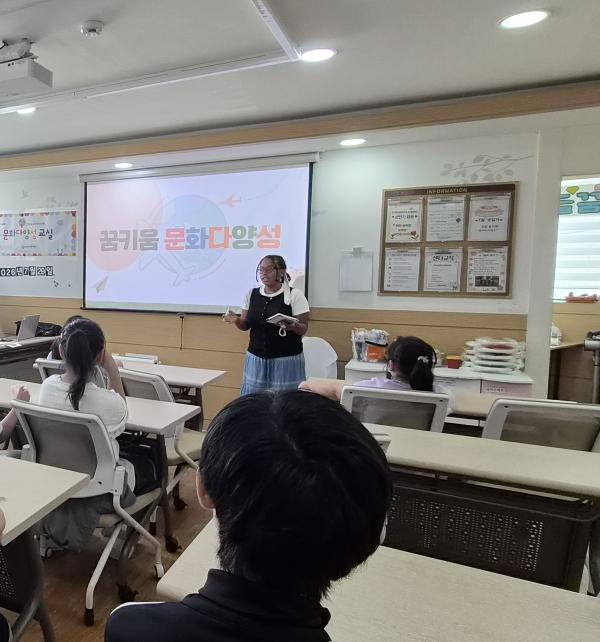
This summer I traveled to South Korea to conduct my senior thesis research on the topic of multiculturalism and diversity in South Korea and how youth are being taught about said topics. My work was focused on a non-profit called CJ Welfare Foundation that has many initiatives, but the particular one I researched is a classroom curriculum that is directed towards youth in welfare centers, giving them the opportunity to learn about various cultures and the existence of diversity in South Korea.
Last summer I worked as an intern with CJ Cultural Foundation and had the opportunity to visit one of the Welfare Foundation’s “Diversity Classrooms”, as they are called, and was so inspired by the work they were doing, I decided to shape my thesis around exploring how the class was being taught and received by students.
My research included visiting two different centers, one in Western Seoul and one in Eastern Seoul, on multiple occasions. The way the diversity classroom is facilitated is with the support of researchers and CJ Welfare Foundation staff a curriculum focused around cultural diversity is created/updated. Independent welfare centers that would like to teach this curriculum to their students apply and over a hundred centers are selected, up to 600 being selected this year, as I was informed in one of my interviews with a CJ Welfare Foundation staff member. CJ Staff over a few classes train welfare center teachers how to conduct the diversity class, as many of the teachers are learning about topics that are foreign to them as well. These trainings also include instruction on how to teach diverse classrooms, as many centers cater to multicultural and non-multicultural youth. After training is finished teachers will begin their classes on their own schedule throughout the summer. The Diversity Classroom booklet has about 7 lessons that are covered. I only visited the welfare centers when the Diversity Classroom curriculum was being taught and was able to see three lessons taught in two different classrooms by two different teachers with different sets of students and demographics in each classroom.
CJ Welfare Foundation’s Diversity Classroom is like an experiment on what education can be like and how expansive and impactful learning can be when the limit is pushed on what can be taught, where, to who, and by whom. As stated on Maeil Business Newspaper’s website, reporting on CJ Welfare Foundation, “An official from the CJ Sharing Foundation said, ‘It is important to understand and respect each other's culture from the current period of children and adolescents when the transition to a multicultural society is accelerating. We will continue to create a sustainable educational environment so that children can grow without prejudice.’”(Lee). Every time I was in the classroom there was a feeling of the unknown, which lent itself to an openness and an excitement in an educational setting, that isn’t always experienced, nor embraced.

My research this summer aligns with the Milken Institute as it is focused on the progress of a meaningful life and tackling global issues. Multiculturalism and understanding how people are trying to cultivate a better and a more open and welcoming society is at the heart of creating a better world. As stated on CJ Welfare Foundation’s website “culture holds the power to raise people, strengthen nations, and build the future”. Researcher, Gloria M. Ameny-Dixon in her paper titled “Why Multicultural Education is More Important in Higher Education Now Than Ever: A Global Perspective” cites research that has compiled long term benefits of multicultural education, one being “Multicultural education renews vitality of society through the richness of the different cultures of its members and fosters development of a broader and more sophisticated view of the world”. Through researching how new discussions and programming are being created to teach youth I was able to better grasp, learn directly, and reflect on how to effectively improve cultural programming more generally. I was given the opportunity to not only sit in during class time, but play along in classroom activities, sit in during dinner time and conduct informal interviews with classroom participants, as well as interviewing classroom teachers and CJ Welfare Foundation Staff. Through the generosity of all the people involved I was able to experience the work of the Diversity Classroom in real time.
The Milken Family Foundation highlights supporting young people through education to achieve its goals. My research is connected as education of youth is my research topic. CJ Welfare Foundation also finds that helping youth is a way in which we can help society and the non-profit’s focus is doing this through cultural programming. My thesis hopes to better understand how diversity exists in South Korea and the direct impact education on these topics can have to the youth and the teachers in the classroom. I hope as I continue my research I can begin to understand the way in which society currently exists, while also trying to shape it better for the future, by learning from those that are trying to do just that. During my summer participating in welfare centers I was able to see how education can shape minds, as well as have a long-lasting impact. One of the beginning lessons was focused on food and how through trade with countries over time, staples in Korean cuisine that are widely known, such as kimchi, wouldn’t exist as they do today without the influence of other cultures. Just this piece of information was able to set a tone for the rest of the lessons for the students to be curious about what parts of Korean culture may be impacted by those that may be seen as different. In one of the classrooms I was in there were students from multicultural backgrounds and so we were able to hear and learn from them about their familial cultures and the co-existence or blending of culture in their households. Conversely the other center I visited had no students of any background outside of Korean ancestry, therefore I was the only foreigner.
My time as a researcher was very special because of this, being a tourist from a foreign country, studying diversity in South Korea. As much as I was curious about the students and their learning, they were curious about me. I was lucky to be able to engage in an exchange of knowledge with the students and see how their thoughts towards me changed over time and how I, too, was changed by them. On my last day in one of the centers during a group interview one of the participants admitted to me about her uncomfortability towards me at the start of the classes, as a result of not knowing much about different cultures, but she happily shared how by getting to know me all her negative feelings disappeared. This simple declaration puts into perspective how by opening up conversations, new ideas and discoveries can be made.
Since I am just at the beginning of my research I will continue to reflect on and analyze the work I did this summer to write my thesis. But what I do know already is that my summer spent in these welfare centers has given me a new way of thinking about and approaching education and cultural programming.
References
Ameny-Dixon, Gloria M. "Why multicultural education is more important in higher education now than ever: A global perspective." International Journal of Scholarly Academic Intellectual Diversity 8.1 (2004): 1-9.
CJ DONORSCAMP. “ Learning to Live Together: The Dream-Growing Cultural Diversity Class | CJ Welfare Foundation.” YouTube, YouTube, https://www.youtube.com/watch?v=4N1nCITq7zc/ . Accessed Oct. 2026.
CJ Welfare Foundation. “CJ Welfare Foundation.” CJ Group, 30 Mar. 2026,https://www.cj.net/kr/en/sustainability/share-group// .
Lee, Hyoseok. “The CJ Sharing Foundation Is Drawing Attention as It Supports Children and Adolescents’ Cultural Edu.. - Mk.” 매일경제, Maeil Business, 27 Apr. 2025, https://www.mk.co.kr/en/special-edition/11302552/ .
Information about how CJ Welfare Foundation programming is facilitated is knowledge I gained through interviews and other information mentioned regarding the classroom and the diversity curricula came from interviews with unnamed participants.
Author(s):
