
Coming of Age in Japan: Investigating Purposeful Aging
Published 08/12/2026 in Scholar Travel Stipend
Written
by Akesh Mallia |
08/12/2026
Turning twenty in Japan is a rite of passage. From ceremonies to photos to celebrations, it is one of the biggest milestones in life. When visiting Japan for this milestone, I asked myself what it means to come of age in an aging society.
I have never thought so much about the number twenty until I came to Japan. I went to Japan to participate in my seijin, or coming of age. As someone half-Japanese, I am familiar with many major milestones, but I do not often get to participate in them. Turning twenty, however, is a unique milestone. It is so unique that the way to say someone is twenty years old has a different word from other numbers, hatachi. Whenever I introduced myself to family members, they would without fail respond, “Oh wow! You’re twenty!”
Part of the Milken Family Foundation’s (MFF) mission is to help people help themselves and those around them live better lives. That encapsulates what it culturally means for someone to turn twenty in Japan. At face value, it is the age at which one begins to contribute to the nenkin, the national pension. A pension is theoretically a way to help people currently in retirement, along with your future self. However, from talking to my mom, there is also the cultural significance of the milestone. As an adult, you are responsible for your own behavior, and you have a duty to your family. You must advance your own goals while helping those around you, and people will notice if you do not.
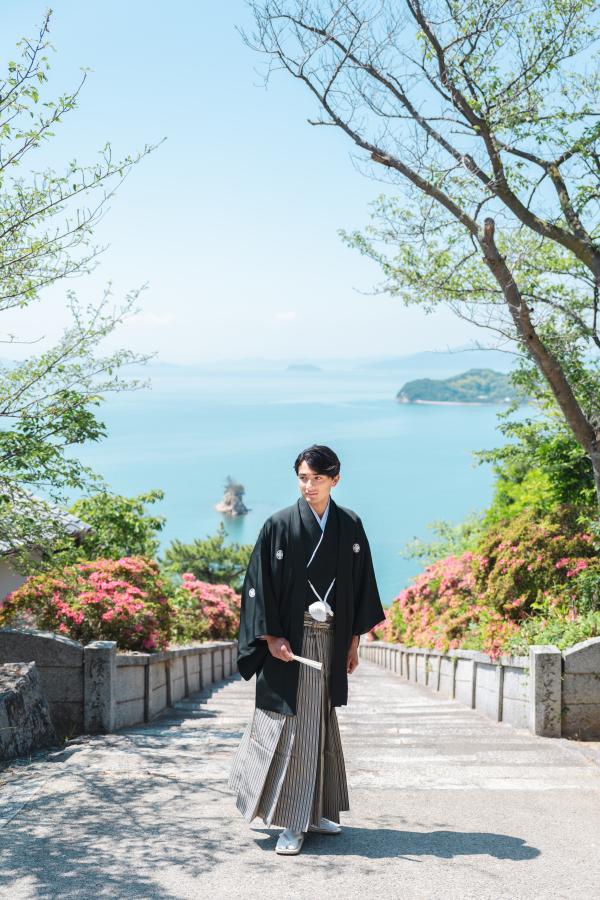
The ceremony that I was lucky enough to have solidifies this cultural significance. Normally, seijin-shiki ceremonies and celebrations occur on the second Monday of January, when everyone turning twenty gathers near the city office in kimono. This day functions as a large reunion, as many of the participants are college students on break. While I did not go to Japan over winter break, I was able to hold my ceremony in summer because my aunt is a Shinto priest on an island called Shodoshima. The ceremony became one of the most meaningful experiences of my trip: the island was beautiful, the hakama and kimono I wore were a perfect fit, the weather was gorgeous, and the photographer was fun to work with. It was special to have my aunt conduct the ceremony for me, which consisted of gratitude, formal blessings, reporting my status to spirits, and wishes for the future.

Seijin-shiki, the Shinto ceremony associated with coming of age.
Experiencing that intentionality made me wonder whether the same philosophy extended beyond coming of age. As I traveled through Japan, I began noticing how that sense of purpose shaped the way communities approached aging as well. An aging world population reflects the type of forward-looking societal challenges that the Milken Institute studies. I was looking out for examples of purposeful aging, not through formalized ceremonies like mine, but through creative actions addressing issues in the community.
One of the first places I noticed this intentionality was in how communities responded to demographic change. As the average age in Japan goes up, there are fewer people to live in homes, especially in the countryside. A staggering 13.6% of houses in Japan are vacant, called akiya, and that number is only increasing (Olsson, 2024). While there are initiatives to sell these houses, one approach I encountered in Shodoshima was art. When exploring the island one day, I came across a house with a giant sculpture of a hermit crab. The sculpture immediately caught my attention because a hermit crab survives by finding a new home, much like these abandoned houses were being given a new purpose. I found it interesting that this art project was supported by the island’s government as part of an islandwide art exhibition. By spurring recreation and tourism, they are taking advantage of a structure that would otherwise have little use.

Vacant house made into an art piece
My grandparents’ home is far from vacant, and with it being a sizeable house, there is always work to be done. My grandfather, who typically does much of the yard work, recently suffered from a medical issue requiring surgery that left him with back pain. So, he called the “silver-san,” a group of retirees who want to continue to give back to the community through various forms of work. In this case, I was surprised to wake up one morning to a team of elderly people trimming bushes and trees around me. It turns out this service is common throughout Japan, with over 670,000 members in this program (Gulrajani, 2026). Hiring non-traditional employees, such as those above retirement age, is a step towards improving individual fulfillment and community success. The silver-san is a system reminding me once more of the MFF value of helping yourself and those around you.
Due to my grandfather’s medical concern, it was important to stay informed as to how to deal with symptoms and recovery. One approach that my grandparents used was tuning into national television when they were broadcasting information specific to my grandfather’s symptoms. This surprised me, as someone who would instinctively do a quick internet search to read up on how to recover from an illness. However, as I looked at my grandparents across the dinner table, I found them actively listening to the TV broadcast and taking notes. They had marked their calendar to watch this show at 8:00 PM, because that was the method of communication that made most sense to them. A study by Sato et al. (2019) was conducted on the effectiveness of TV program health communication in Japan. They found that older females exposed to TV health programming had a lower rate of mortality, whereas older males did not. Regardless of mortality, what was clear to me is that this method of communication eased anxiety and improved the quality of life of my grandfather. Being intentional with methods of communication to an older population is critical.

Television show detailing strategies for taking care of elderly family members.
When I first arrived in Japan, I wondered what it meant to come of age in an aging society. I left realizing that adulthood is defined not only by personal independence, but also by the responsibility to understand and contribute to the communities around us. The Milken Institute’s mission is to study global issues through both the lens of the present and the future. The challenges relating to aging are not unique to Japan and may indicate the future of some other countries in the world. During my trip, I saw how thoughtful decisions can improve lives across generations, whether through repurposing vacant homes, creating meaningful opportunities for retirees, or communicating health information in ways that best serve older adults. My coming of age ceremony celebrated my transition into adulthood, but it also challenged me to think beyond my own future.
References:
Gulrajani, B. (2026, March 7). Working overtime: ‘Silver Jinzai’ centers keep Japan’s seniors employed. The Japan Times. https://www.japantimes.co.jp/life/2026/03/07/lifestyle/elderly-workforce-silver-jinzai-aging-population/
Olsson, J. (2024). The Akiya Phenomenon, Revitalisation, and Resistance: Investigating Vacant Houses as a Tool for Repopulation in Rural Japan. Asia in Focus, (10). https://journals.lub.lu.se/asiainfocus/article/view/25725
Sato, K., Viswanath, K., Hayashi, H., Ishikawa, Y., Kondo, K., Shirai, K., Kondo, N., Nakagawa, K., & Kawachi, I. (2019). Association between exposure to health information and mortality: Reduced mortality among women exposed to information via TV programs. Social Science & Medicine, 221, 124–131. https://doi.org/10.1016/j.socscimed.2018.12.019
Author(s):
