
Beyond Frivolity: Making the Most of a Brief Stay in Japan
Published 12/10/2025 in Scholar Travel Stipend
Written
by Lena Jones |
12/10/2025
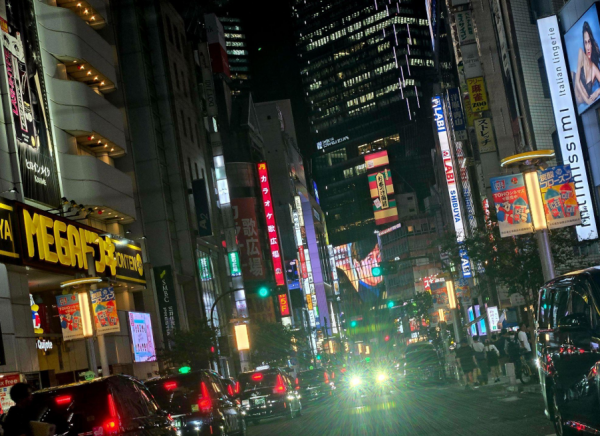
To celebrate graduating in May 2025, I went to Japan. Three friends and I crammed all that we could into one week, separating the trip into three cities: Tokyo, Kyoto, and Hiroshima. Since we had a limited time to internalize the people, personalities, food, scenery, and experiences of these locations, we tried to make our intentions clear. For every piece of frivolous fun, we bore a deeper analytical purpose in mind.
In Tokyo, we wanted to shop, not merely for material goods, but to understand how consumerism plays out in another capitalist nation. In Kyoto, we planned a “shrine day,” partly out of a desire to hike, and partly to begin understanding the spiritual significance of the numerous holy sites across the country. Lastly, in Hiroshima, we hoped to see a vastly different part of Japan and visit the Hiroshima Peace Memorial Museum, learning about the traumatic end of World War II from the perspective of those who suffered the most. All our lives, we had experienced capitalism, religion, and history lessons about the dropping of the atomic bombs from the United States’ perspective. Visiting Japan was a brief, marvelous chance to flip everything we thought we knew about industry, spirituality, and history on its head.
My observations about capitalism in the nation’s capital quickly took an unexpected turn away from material consumption. As we hustled through Tokyo, my background in public health program evaluation clued me in to how Japanese infrastructure and advertising culture encourage health and well-being among the citizenry. With Japan’s statutory health insurance system, a variation of the German Bismarck model, employer-based and residence-based healthcare give employees, the unemployed, and the elderly ample options by not requiring them to “register with a practice” (Tikkanen et al.). Of course, all this choice only matters if people can access care. Their public transportation system and highly capitalistic culture of advertising one’s services made encountering new sources of care very easy. My friends and I used public transit between and within cities throughout our trip, which built exercise into our everyday plans, and we were never overly inconvenienced by a late train or an uncomfortable bus ride. Ample room was left available for disabled and elderly riders, regardless of how full the space became. This common culture of courtesy and polite helpfulness extended to retail settings, incentivizing repeat customers. While visiting a pharmacy just outside Tokyo, for instance, the cashier explained the health risks and proper uses of an over-the-counter anti-irritation medicine for me in great detail, as though she were my primary care physician. In short, a unique combination of culture, economic norms, and accessibility ensured that their universal healthcare system could continue to thrive in a staunchly capitalistic environment.

As we moved on to Kyoto, we took the Shinkansen bullet train. I began to realize just how integral thoughtful spending, collective determination, and innovation were to Japan’s successes across industries, notably the success of the Shinkansen. I learned from one of my friends that the strange, duck-billed nose of the bullet train had not always been that way. Originally, the nose looked like an actual bullet, but this design resulted in a cacophonous sound and a dangerous change in pressure whenever the train passed through a tunnel (Katwala). Japan invested the modern equivalent of ¥1.8 trillion into this world-renowned innovation (“Japan’s Shinkansen: How Does It Stack Up Worldwide?”), facing an unforeseen and inconvenient flaw in the design head on in the process. No region or province was left behind during the upgrade. Japanese citizens collectively benefited from the final product, which more than paid for itself by connecting far-flung regions to Japan’s economic centers. Prudent spending, collective determination, and innovation clearly optimized the outcome of the original Shinkansen project.
The value of collective determination continued to resonate as I observed the architecture and recycling culture in Kyoto. In and around major cities, high buildings filled with businesses on every floor were interspersed with shrines, small and large. Some included large, red torii (gates) or stone kitsune (fox) statues tucked into shrubbery. Whether in the shrine or on the street, space was filled deliberately, or space was allowed to be filled by natural greenery, and trash was all but absent. People carried their wasted paper, plastic, or compost around in small bags until the end of the day, when they could return home and recycle. I was struck by the individual and collective self-discipline required to maintain a society like this, where available space was used to the fullest before erecting gratuitous buildings, laws on littering were respected, and beautiful shrines were open to the unsupervised public deep into the night.

More than a social contract to behave well for the collective, this value of collective determination seemed linked to the Japanese indigenous religion of Shintō. Though this religion has undergone countless ideological evolutions since the 4th century C.E. (Hirai), throughlines can be identified. In Shintō, all kami (or deities, crudely translated) “are said to cooperate with one another, and life lived in accordance with a kami’s will is believed to produce [...] the protection, cooperation, and approval of all the particular kami” (Hirai). Practitioners are also called to cultivate magokoro (“true heart” or pureness of heart) through awareness of these deities, ultimately culminating in doing one’s best in work and relationships (Hirai). Cooperation for a higher purpose, then, is a quality of the gods, and mindfulness toward the gods brings about one’s best, most sincere actions toward those around you. After drawing these connections back to everyday habits like resisting waste and maintaining clean public spaces, I was grateful to become more aware of how spirituality in Japan continues to inform social standards and values.
Finally, my friends and I visited the Hiroshima Peace Memorial Museum. A two-hour train and bus ride through the city introduced us to the thriving metropolis that is present-day Hiroshima. Within the museum, the juxtaposition between this imagery and the devastation faced by the city in the wake of the United States’ dropping of the atomic bomb rattled us. Tens of thousands of Japanese people died of fourth-degree burns, lost skin, mourned family, and experienced chronic illness and radiation-related disfigurement. Only the glaring reds and blinding light colors in paintings from survivors could fully convey the terror of the bomb’s aftermath, as journalists’ subsequent photographs were taken in black and white. The vast majority of Edo period architecture, ornate wooden structures that had left me and my friends awestruck in Kyoto, was disintegrated or burned in the blast.

The museum and surrounding park are monuments to peace, nuclear disarmament, and the horrors of nuclear weapons use (“Home: HPM Museum”). The ideological and political motives of the Japanese Empire during World War II were mentioned in passing at most; this was not the purpose of the museum. Similarly, the United States’ motives for resorting to such extreme measures were given a mere paragraph of text: according to the museum’s exhibit on the Dangers of Nuclear Weapons (“Exhibition Zone 6: HPM Museum”), the U.S. dropped atomic bombs on Nagasaki and Hiroshima to end the war before the Soviet Union could declare war and exert its influence on the region, as well as to justify the high cost of the Manhattan Project to the American people (“Item 61: Exhibition”). In the U.S., we are told that our government needed to drop the bombs to end the war, because driving the Japanese to surrender via direct invasion would require the loss of many more American lives. This declaration of a blatantly political and transactional rationale was unlike anything I’d ever been taught back home, but more shocking than this was the delivery of this perspective by the museum exhibit. Though moral judgments could easily be cast on the U.S., the museum’s primary purpose was never neglected in pursuit of transnational chastisement. The message was clear: atomic bombing is a line our world must never cross again, and we must sacrifice our nationalist ideals of justice and self-preservation to ensure the safety of future generations from nuclear warfare. I wholeheartedly agree with this reconciliatory sentiment, and I applaud the museum for unequivocally promoting peace after the suffering Hiroshima endured.
Of course, my friends and I enjoyed frivolous activities. We hiked the Senbon Torii shrine in a thunderstorm and got lost in the country’s largest Don Quixote retail store for the better part of a day. We enjoyed okonomiyaki, a post-World War II staple food made from anything available to those who survived Hiroshima. Nevertheless, frivolity was not the core of our trip. These memories were made sweeter by moments of solemnity, gratitude, and deep introspection. They were balanced by our keen awareness of being invited into a nation much different from, and yet economically and historically intertwined with, our own.

Works Cited
“Exhibition Zone 6: HPM Museum.” HPM Museum, http://hpmmuseum.jp/modules/exhibition/index.php?action=ZoneView&zone_id=6&lang=eng. Accessed 15 Oct. 2025.
Hirai, Naofusa. “Shintō - Kami, Mythology, Literature.” Britannica, Encyclopædia Britannica, 29 Sept. 2025, https://www.britannica.com/topic/Shinto/Shinto-literature-and-mythology. Accessed 14 Oct. 2025.
“Home: HPM Museum.” HPM Museum, http://hpmmuseum.jp/?lang=eng. Accessed 15 Oct. 2025.
“Item 61: Exhibition.” HPM Museum, http://hpmmuseum.jp/modules/exhibition/index.php?action=ItemView&item_id=61&lang=eng. Accessed 15 Oct. 2025.
“Japan’s Shinkansen: How Does It Stack Up Worldwide?.” Nippon.com, https://www.nippon.com/en/in-depth/d01046/. Accessed 14 Oct. 2025.
Katwala, Amit. “ALFA‑X: The Unreal Science of Japan’s 400 kph Bullet Trains Explained.”
WIRED, 17 May 2019, https://www.wired.com/story/japan-bullet-train-alfa-x-nose/. Accessed 14 Oct. 2025.
Tikkanen, Roosa, Robin Osborn, Elias Mossialos, Ana Djordjevic, and George A. Wharton.
“Japan.” International Health Care System Profiles, The Commonwealth Fund, 2020, https://www.commonwealthfund.org/international-health-policy-center/countries/japan. Accessed 14 Oct. 2025.
Author(s):
