
Walking Softly Through Sacred Spaces: My Search for the Meaning of Khalistan
Published 03/30/2026 in Scholar Travel Stipend
Written
by Simaranjeet Rai |
03/30/2026
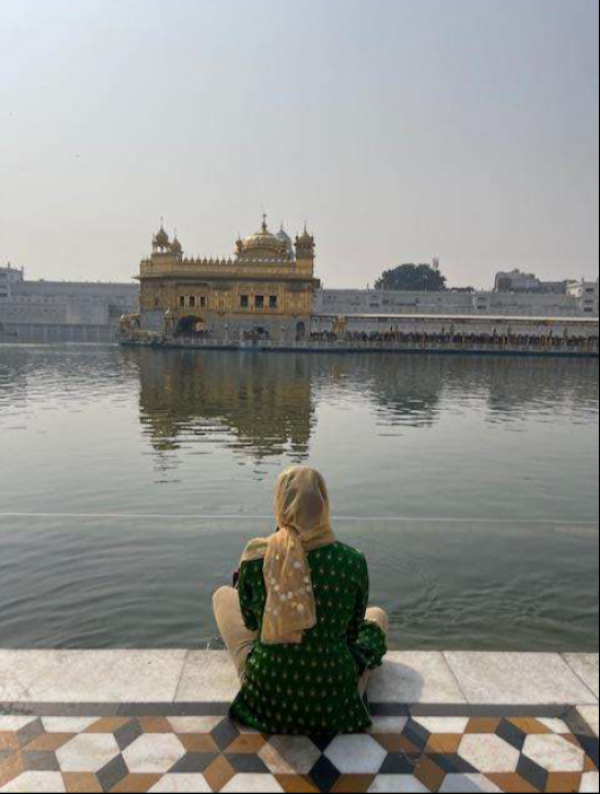
I first became interested in Khalistan through real-life encounters with Sikh communities in California. At the annual Nagar Kirtan in Yuba City and later at a major Sikh event at the Los Angeles Convention Center in DTLA, I noticed clusters of people holding bright yellow flags emblazoned with the Khanda and sometimes the word Khalistan. Their energy was passionate, and I sensed the flags represented something deeply meaningful, more than just political slogans. I wanted to understand more about Sikh history, identity, and the origins of these symbols. I wanted to understand my history.
I traveled to India and visited four historically significant gurdwaras: Harmandir Sahib in Amritsar, Bangla Sahib in Delhi, Anandpur Sahib in Punjab, and Guru ka Tal in Sikandra.
Yet when I asked a close family member in India about Khalistan, they responded sharply: "You will be hung by your hair if you even utter the word." Their fear startled me. It made me realize how politically sensitive the topic still is in India, even decades after the insurgency ended. From then on, I did my research quietly, determined to understand why Khalistan evokes such strong, conflicting emotions across different Sikh communities.

Khalistan's Emergence
To appreciate why some Sikhs rally behind Khalistan while others fear or reject it, we must understand the movement's origins. Sikh identity has long contained elements of spiritual sovereignty and resistance, dating back to the Khalsa's formation in 1699 and the Sikh Empire under Maharaja Ranjit Singh (Singh, 2007). After India's independence, many Sikhs felt politically marginalized, especially during disputes over language, water rights, and Punjab's boundaries.
Tensions escalated when demands for greater autonomy were misunderstood as separatism (Tatla, 1999). T he situation worsened in 1984, when Operation Blue Star-the Indian Army's assault on the Golden Temple to remove militants-left deep emotional scars. Later that year, anti-Sikh pogroms in Delhi killed thousands more, fueling distrust and giving rise to a violent insurgency in Punjab. Although the insurgency collapsed by the mid-1990s, memory of 1984 remains central to Sikh identity and to contemporary diaspora activism (Kaur, 2011).
Within India today, public expressions of Khalistan are taboo or even dangerous, while in the diaspora the idea often functions as a symbol of justice, remembrance, and Sikh sovereignty rather than a literal political project (Singh & Tatla, 2006). My own experiences - spanning the diaspora and India - helped me see this contrast firsthand.
How Each Gurdwara I Visited Connects to Sikh Memory and Khalistan
Visiting India allowed me to stand in the very places whose histories shape the emotions surrounding Khalistan. Each gurdwara revealed a different dimension of Sikh identity: spiritual, historical, political, and ethical.
Harmandir Sahib (Amritsar): Spiritual Heart and Site of Collective Trauma
The Golden Temple is breathtaking in its beauty: the gleaming gold, the calmness of the sarovar, and the endless seva draw millions each year. But beneath its serenity lies the weight of history. This is where Operation Blue Star unfolded in 1984, an event that marked one of the most significant ruptures between Sikhs and the Indian state (Tully & Jacob, 1985).
Walking by the Akal Takht, I sensed why diaspora Sikhs carry yellow Khalistan flags. For many, the assault on the Temple is not simply political; it is emotional, spiritual, and deeply personal. Being there made me understand that for some, Khalistan is less about borders and more about dignity and justice connected to this sacred space.
Bangla Sahib (Delhi): Seva Amid the Shadow of 1984
Bangla Sahib, with its peaceful sarovar and constant langar, reflects the Sikh commitment to seva: service above all. Yet Delhi is also where the 1984 anti-Sikh violence occurred. Just miles from this gurdwara, mobs killed thousands of Sikhs in the days following Indira Gandhi's assassination.
Standing on its marble floors, I thought of how many Sikh families still carry the pain of losing loved ones in Delhi. This is why diaspora communities often link Bangla Sahib to Khalistan politics: the gurdwara symbolizes the contrast between Sikh generosity and the brutality Sikhs faced in the capital. In Yuba City and DTLA, many who held yellow flags were families shaped by stories from Delhi.

Anandpur Sahib (Punjab): Birthplace of the Khalsa and Symbol of Sovereignty
Anandpur Sahib is where Guru Gobind Singh established the Khalsa in 1699. Visiting it felt like walking into the birthplace of Sikh sovereignty itself. The Khalsa identity-warrior-saints committed to fighting oppression-is often invoked in conversations about Sikh autonomy, dignity, and self-rule.
Many Khalistan narratives draw symbolic energy from Anandpur Sahib because it was here that Sikhs were first commanded to stand fearlessly, defend the oppressed, and never bow to tyranny (Oberoi, 1994). Seeing the site in person helped me understand why Sikh sovereignty is not just political-it is spiritual and ethical.

Guru ka Tat (Sikandra): Martyrdom and the Ethos of Justice
Guru ka Tal, associated with Guru Tegh Bahadur's martyrdom, embodies Sikh commitment to religious freedom for all, not just Sikhs. Guru Tegh Bahadur sacrificed his life defending Kashmiri Hindus from forced conversion, making Sikh martyrdom fundamentally about protecting the oppressed.
This visit reminded me that Sikh political memory is grounded in justice, not aggression. Any modern movement, including Khalistan, must be viewed within this ethical framework. Guru ka Tal taught me that Sikh history is about courage and compassion, and that any political discussion must be rooted in these values.

Conclusion
My journey – from seeing yellow Khalistan flags in Yuba City and DTLA, to quietly researching the movement to finally walking through India’s most sacred gurdwaras – showed me the complexity of Sikh identity. My research taught me that even within the Sikh community, perspectives on Khalistan are deeply divided: in California, the movement is often a symbol of justice and remembrance, while in India, the very word can evoke fear and repression. Witnessing these contrasts firsthand revealed how history, trauma, and context shape political memory, even among people who share the same faith. This experience aligns with the Milken Institute’s mission to improve lives through global understanding and informed dialogue, and the Milken Family Foundation’s focus on education, leadership, and human dignity. Given that India is the most populous country in the world and Sikhs constitute a significant religious and cultural community, understanding their (and my) history and perspectives is crucial for fostering cross-cultural awareness and informed engagement.
My travel and research deepened my understanding of intersectionality—how religion, nationality, diaspora identity, and historical trauma intertwine to shape people’s worldviews. In academic and professional spaces, this awareness translates into an ability to listen across differences—whether discussing identity in a seminar or collaborating on a project with colleagues from varied backgrounds. By approaching conversations through the lens of intersectionality, I can create space for multiple truths to coexist, encouraging dialogue that values empathy as much as analysis. In this way, what I learned through exploring Sikh identity and diaspora communities continues to shape how I engage with peers: with curiosity, humility, and a commitment to understanding the deeper contexts that shape every voice in the room.
References
Kaur, H. (2011 ). 1984 and the shaping of Sikh memory. Sikh Formations, 7(3), 321-339.
Oberoi, H. (1994). The construction of religious boundaries: Culture, identity, and diversity in the Sikh tradition. University of Chicago Press.
Singh, K. (2007).A history of the Sikhs: Vol. 1. 1469-1839. Oxford University Press.
Singh, G., & Tatla, D. S. (2006). Sikhs in Britain: The making of a community. Zed Books.
Tatla, D.S. (1999). The Sikh diaspora: The search for statehood. University of Washington Press.
Tully, M., & Jacob, S. (1985). Amritsar: Mrs. Gandhi's last battle. Pan Books.
Author(s):
