
The Glow Offensive: How K-Beauty Became Korea's Softest Export
Published 05/20/2026 in Scholar Travel Stipend
Written
by Lina Lin |
05/20/2026
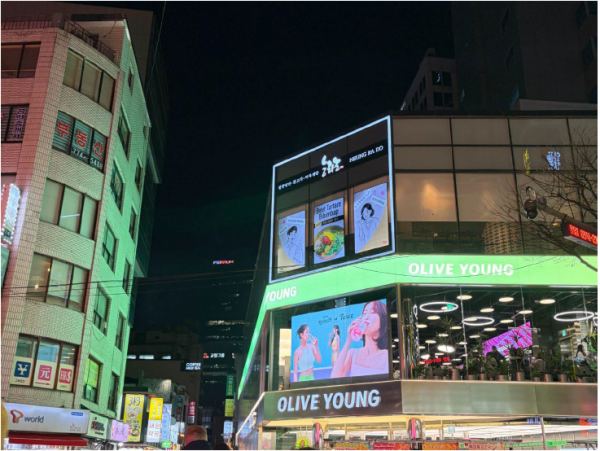
The amber glow of Olive Young storefronts followed me everywhere through Myeongdong, day and night, relentless and warm. Korea's dominant health and beauty chain operates over 1,380 stores across the country (CJ Olive Young, 2025), and walking through Seoul's main shopping district, I believed every single one of them. The lighting was engineered to make your skin look like it needed fixing, and everyone around me seemed to already have the answer.
That answer, apparently, is working. Outbound shipments of Korean beauty products rose 12.3 percent in 2025 to a record $11.43 billion USD. In the first half of that year alone, South Korea surpassed the United States to become the world's second-largest cosmetics exporter, after France, with cosmetics exports surging 15 percent over that six-month period to a record $5.5 billion (The Korea Herald, 2025). These are not niche numbers. This is an industrial force.
The infrastructure behind that force is partly political. The KORUS Free Trade Agreement eliminates tariffs on over 95 percent of industrial and consumer goods between the US and Korea, smoothing the path for exactly this kind of export surge (U.S. Customs and Border Protection). But KORUS is just the plumbing. The deeper architecture is globalization itself: the interlocking system of liberalized trade, digital distribution, and cultural transmission that has made it possible for a sheet mask manufactured in Incheon to land on a bathroom shelf in Ohio within a week. K-beauty didn't conquer global markets by accident. It moved through infrastructure that was already built, and it moved fast.
Part of what makes K-beauty so difficult to compete with is that it wins on multiple fronts simultaneously. Korean cosmetics brands have managed something unusual in the consumer goods world: they are genuinely innovative, reasonably priced, and aesthetically refined all at once. The formulations are sophisticated. Ingredients like centella asiatica, fermented rice water, and snail secretion filtrate moved from Korean dermatology labs into mass-market products years before Western brands caught on. The packaging is considered. The price points are accessible. A product that would retail for $60 under a French luxury label sells for $18 in an Olive Young, and in many cases outperforms it clinically. That combination, high technology at democratic prices, is not an accident of the market. It is the result of sustained investment in cosmetic research and development, compressed product cycles, and a domestic consumer base sophisticated enough to reject anything that doesn't actually work.

But trade policy alone doesn't explain why American teenagers are buying snail mucin serums. For that, you need culture.
K-beauty's global ascent was turbocharged by a broader Korean cultural wave: BTS and Blackpink commanding stadiums worldwide, Squid Game becoming Netflix's most-watched series ever, Korean food and fashion seeping into mainstream consciousness across continents. Culture, beauty, food, and fashion cross-pollinate. K-beauty didn't just ride that wave; it is part of it. The number of licensed cosmetics sellers in South Korea nearly doubled, to about 28,000, in 2024 from five years earlier (Gilchrist, 2025). K-beauty is not a trend. It is a cultural brand, and it is being exported deliberately.
Deliberately is the operative word. The South Korean government has long viewed cultural exports not as a byproduct of economic activity but as a strategic instrument of foreign policy. Since the late 1990s, Seoul has funneled significant public investment into the creative and beauty industries, treating them as diplomatic assets as much as commercial ones. Government agencies promote Korean beauty brands at international trade expos, fund research into cosmetic biotechnology, and coordinate with entertainment exports to ensure that K-pop and K-beauty arrive in foreign markets together, mutually reinforcing. This is soft power exercised with the precision of industrial policy. The Korean wave doesn't just happen. It is, to a meaningful degree, administered (Korean Economic Institute of America, 2023).
That deliberateness also has a corporate architecture behind it. Korea's economy has long been organized around chaebols: the massive family-controlled conglomerates that dominate everything from semiconductors to shipbuilding to retail. Amorepacific, the company behind brands like Laneige, Sulwhasoo, and Innisfree, is itself a chaebol-adjacent giant that has spent decades engineering the global perception of Korean beauty as premium, aspirational, and scientifically advanced. CJ, another major conglomerate, sits behind not just beauty but food, entertainment, and logistics: the full soft power stack, vertically integrated. When K-beauty goes global, it rarely goes as a scrappy indie export. It goes as a coordinated cultural and commercial offensive, backed by the kind of capital and distribution muscle that only a chaebol system can produce. The Korean wave is partly organic, partly engineered, and the line between the two is deliberately blurred.
Walking through Seoul, I felt the weight of that brand in a way the export statistics don't quite capture. In the major shopping districts, it seemed like everyone was applying the same makeup, the same creams, converging on the same features. Billboards advertising the "K-face" look were everywhere. My honest first reaction was that everyone looked the same, and that uniformity, I started to realize, wasn't accidental.
The Korean beauty ideal is specific: glass skin, a youthful and innocent appearance, a highly refined finish. Even the makeup techniques being promoted in stores were all chasing the same things: emphasizing the aegyo-sal, the subtle fullness beneath the eye; achieving luminous, clear skin; mimicking a no-makeup makeup look. The standard isn't just aesthetic. It's social infrastructure.

It comes with a cost. South Korea has one of the highest rates of cosmetic surgery per capita in the world. The procedures most in demand, double eyelid surgery, rhinoplasty, jaw reduction, are not about individual expression. They are about conformity to a template. That template is not neutral. It leans toward features historically associated with Westernized or Eurocentric ideals of the face, filtered through a specifically Korean aesthetic language. The result is a beauty standard that is simultaneously distinctly Korean in its framing and quietly assimilationist in its geometry. Globalization exports K-beauty outward; it also imports certain pressures inward, and those pressures land hardest on the people who can least afford to meet them.
A friend of mine at Yale told me something that stuck with me. Her relative, back in Korea in middle school, was being bullied by classmates over the shape of her eyes. When her parents brought it to the teacher, the teacher essentially agreed, and now the girl is considering surgery. In the US, that story would be unthinkable. A teacher validating that kind of bullying would be a scandal. In Seoul, apparently, it was a suggestion.
That's what makes K-beauty more than a market story. South Korea's cosmetics industry has become a vehicle for soft power, transforming the country into a cultural exporter with genuine global reach. But soft power has a domestic face too. The same standards that make Korean beauty aspirational abroad make it compulsory at home. The glass skin that sells in Sephora is a baseline expectation in Seoul. The chaebol machine that packages and exports the Korean beauty ideal profits from both ends: from the Western consumer who wants to look dewy, and from the Korean teenager who feels she has no choice. The government that funds the export offensive and the corporation that executes it share little of the cost borne by the people the standard was built around.
 The export of beauty culture as soft power isn't just a theory. It's actively unfolding, with real stakes on both ends: the American consumer who discovers Korean skincare through a TikTok algorithm, and the Korean middle schooler who discovers that her eyes are the wrong shape. Both are living inside the same brand. One of them chose it. The other was born into it, and the bill comes due differently.
Sources:
CJ Olive Young. (2025, December). History. Retrieved May 2, 2026, from https://corp.oliveyoung.com/en/company/history/
Gilchrist, K. (2025, November 27). How K-beauty conquered the world — and TikTok. CNBC. https://www.cnbc.com/2025/11/27/k-beauty-tiktok-makeup.html/
Korea Economic Institute of America. (2023, July 11). The rise of K-beauty and the economic implications for South Korea. The Peninsula. https://keia.org/the-peninsula/the-rise-of-k-beauty-and-the-economic-implications-for-south-korea/
The Korea Herald. (2025, July 6). S. Korea becomes world's No. 2 cosmetics exporter in H1. https://www.koreaherald.com/article/10652611/
U.S. Customs and Border Protection. (n.d.). U.S.-Korea Free Trade Agreement (KORUS).https://www.cbp.gov/trade/priority-issues/trade-agreements/korea/
Author(s):
