
Sanhujori and Korean Postpartum Policy: Lesson for Maternal Health and Economic EquityNew Item
Published 03/23/2026 in Scholar Travel Stipend
Written
by Marisol León |
03/23/2026
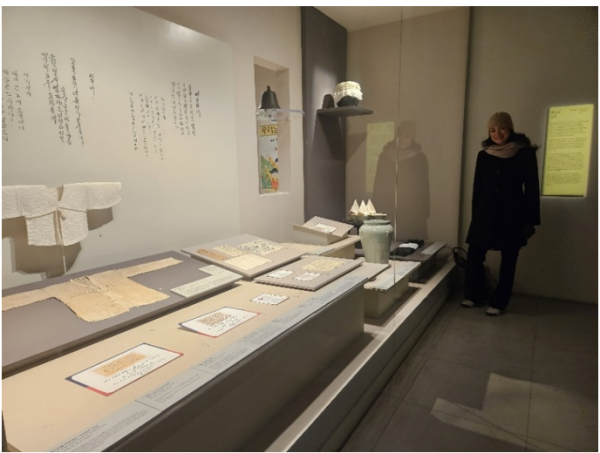
My research into postpartum support offered to women in South Korea started at the National Folk Museum of Korea located in Seoul within the grounds of Gyeongbokgung Palace. I was particularly interested in the permanent exhibition on birth and early life rituals showing how Koreans have historically understood pregnancy, motherhood, infancy, and hope for a child’s future.
Sanhujori: Historical Background
The Exhibit showcases aspects of sanhujori, or postnatal care, that consists of food, rest, and care for the mother. It highlights infant milestones such as baekil—a significant Korean tradition celebrating a baby's survival through their first 100 days, marking a major milestone for health and longevity (historically, it honored infants surviving high mortality rates)[1]—and doljabi, a traditional Korean first birthday party where a baby is placed before various items and encouraged to select one or two to predict their future, career, and fortune. This ritual, deeply rooted in Korean culture, symbolizes blessings for a prosperous, healthy life.[2] As I explored the Exhibit, I thought about how these rituals reflect a historical understanding that maternal well-being and infant survival are communal responsibilities, not private or women-specific burdens—an insight that has contemporary relevance when considering the lack of systemic policies that support working mothers and equitable postpartum care in California.[3]
The photographs of the Exhibit below show offering bowls, folded ritual paper, and ceremonial stands, as well as ceremonial baby clothing. In Korea, birth was and continues to be understood as a long process, not a single event. Sanhujori therefore frames childbirth as something that requires community support, and in traditional Korea, it referred to a system of care for the mother after childbirth, usually lasting 21–100 days, meant to a) restore the mother’s body, b) protect her from illness later in life, c) ensure successful breastfeeding, and d) safeguard the newborn’s health. By framing childbirth in this way, historical sanhujori implicitly recognized the long-term benefits for women’s ability to participate fully in society. In contrast, postpartum care in the United States traditionally consists of a single medical visit approximately six weeks after birth.[4] To this day, in Korea sanhujoriis considered essential, not optional.


Sanhujori: Postnatal Care in Korea Today
To get a better understanding of how sanhujori operates in Korea today, after my visit to the National Folk Museum, I spoke to women and men about postpartum care options and who can participate in them.
I asked Cathy if her sister chose a public or private Postpartum Care Center and she said it was private although public ones were available. I asked her what the difference between the two entailed and she explained that private facilities can provide customized meals, education programs, spa programs, etc., based on the mother’s labor and delivery method, lactation plan, and the mother's health and psychological conditions. Public maternal care on the other hand, Cathy explained, operates out of national or municipal hospitals and is integrated with the national health insurance system. At public hospitals prenatal checkups, delivery, and medically necessary postpartum care are largely covered, which makes them more affordable and accessible than private facilities. However, Cathy noted that these hospitals tend to be busier, more standardized, and more clinically focused. Rooms are often shared, visiting hours are limited, and postpartum stays are shorter. She said they focus on medical safety and efficiency which can be an excellent option for high-risk pregnancies. Since her sister’s pregnancy was not high-risk, she wanted a more personalized postpartum experience. While emotional or comfort-based care exists at public hospitals, Cathy said her sister wanted more individualized care.
Listening to Cathy’s explanation of the differences between public and private postpartum options in Korea highlighted a potential equity challenge: while private centers in Korea can provide personalized care that is more conducive to holistic recovery and workforce reintegration, these private Postpartum Care Centers are often financially out of reach for low-income families. At private Postpartum Care Centers, expecting mothers can stay for several weeks; they offer private rooms, hotel-like amenities, round-the-clock newborn care, lactation consultants, tailored meals, massages, and classes — all at significant cost, often only partially covered or not covered at all by insurance. Public centers—though safe and more affordable—unfortunately offer less tailored support. This raises questions about how universal postpartum policies could ensure both safety and individualized care for Korean mothers and their newborns.
Culturally, private Postpartum Care Centers reflect a continuation of traditional sanhujori: the mother rests, her job is temporarily “suspended,” and care is collectively provided — just in a modern, commercial form. Cathy told me that Korean families navigate a mix of both public and private maternal care, often choosing public hospitals for safety and private clinics for the deeply valued postpartum period. She noted that her family believes a mother’s care before and after birth shapes the child’s future and this made sense after learning about historical sanhujori at the National Folk Museum.
After speaking with Cathy, I was very curious to learn more about private Postpartum Care Centers and their offerings. I did some research and decided to visit the Postpartum Care Center located at the CHA Ilsan Medical Center. There, I spoke to Minseo, a nurse, who told me that that particular Postpartum Care Center is known for combining obstetrics with wellness-style recovery. Before she was hired, Minseo completed specialized training in maternal–newborn nursing, lactation support, and emergency neonatal response, on top of her RN license. Her days were spent monitoring mothers’ vitals, caring for newborns in the nursery, guiding first breastfeeding sessions, and coordinating services the clinic was known for—customized postpartum meals, wound care, infant bathing instruction, and scheduled rest periods designed to support sanhujori in a modern and tranquil setting.
Minseo explained that for the prevention of infection, the mother and baby should refrain from leaving the premises during their length of stay. Visitation is also restricted although husbands can stay overnight. Minseo and I chatted outside of the Center because of these restrictions, which Minseo enforced gently but firmly. Inside, she explained, the Center maintained a tightly controlled environment to protect recovering mothers and newborns from infection, overstimulation, and disrupted rest. Family members could watch their babies through the nursery glass or receive updates by phone, but the rooms beyond were kept quiet, warm, and private. I asked Minseo what the average length of stay was and she said typically no less than two weeks.

In terms of what the Postpartum Care Center at the CHA Ilsan Medical Center offers, Minseo said there are 24-hour professional nurses available for newborn care who are able to quickly respond to medical emergencies that might occur to newborns as the NICU and pediatrics department is located within the same building. Pediatricians make rounds to the nursery, and the observation room, nursing room, and washing room are separated to systematically manage infection control. There’s an air purifier inside the nursery to maintain clean air, and there’s continuous monitoring from the Infection Control Department. All equipment used in the nursery is thoroughly sterilized and the nursery is disinfected by using UV sterilizers daily.
For mothers, the Postpartum Care Center provides a one stop service from prenatal care to delivery to postpartum care. Restricting visitors helps provide maximum relaxation to the mother. There’s a hotel-style heater and air conditioner and an emergency call bell installed in all rooms. Minseo also shared that lectures by pediatricians, obstetricians, and psychiatrists are provided to mothers which help them better manage their baby’s health, their own health after delivery, and their mental health postpartum, respectively.
After speaking to Cathy and Minseo, I sought to understand Korean men’s experiences with Postpartum Care Centers. I first spoke to Eric who is married, has two young children, and works at a dermatology clinic. Eric shared that both of his wife’s deliveries were at a private women’s hospital connected to a Postpartum Care Center (similar to the one connected to the CHA Ilsan Medical Center, but he said it was not as “luxurious.”) Eric noted that while he returned to work during the week after his wife gave birth, he was expected—by his family and by the clinic—to stay with his wife on weekends. He learned how to swaddle, how to sterilize bottles, how to move quietly through a recovery room where rest was treated as medicine. No one praised him for “helping;” Eric said this was simply what a husband did during those first weeks. Speaking with Eric made it clear that sanhujori also deeply influences how Korean men perceive and experience childbirth and postpartum care. I couldn’t help but think about how men (and some women) often frame childcare in the United States as individual effort balanced against work, something negotiated or admired when done well.[5] In Korea, this role feels more collective and time-bound: labor happens within a system that temporarily slows everything down—including the mother’s career and father’s own professional and social life.

Before the end of my trip, I was also able to speak to Jun who works in the tourism industry and is the father of a young child. When his wife became pregnant, they decided to pay for a private women’s hospital and Postpartum Care Center, even though it meant careful budgeting. He noted the difference was immediate: prenatal appointments were unhurried, delivery rooms were calm and private, and after the birth his wife moved into the Center where nurses handled nighttime feedings so she could heal. Jun was allowed to stay on weekdays and weekends, sleep in the room, and learn how to hold his son without the pressure of exhaustion. Jun noted how special this was for him since he felt included rather than “in the way.”
Jun noted their choice to go private wasn’t about luxury so much as structure. When families can afford private maternal clinics in Korea, Jun said they often choose them because the system is gentler on everyone involved (although he did complain about thehefty price tag). At private Postpartum Car Centers, mothers are given real time to recover, babies are closely monitored, and fathers are folded into care instead of left hovering at the margins.
Lessons for California
These accounts illustrate how structured postpartum care not only supports maternal recovery but also facilitates fathers’ involvement and smooth transitions back to work. For California, this suggests that integrated family-support systems—combining medical, emotional, and logistical support—could help increase workforce participation among new mothers without sacrificing recovery. [6]
South Korea’s system integrates cultural expectation, public and private health infrastructure, and family involvement in a way that collectively supports women’s postpartum health. By contrast, California’s current approach often places the burden on individual mothers and families, particularly low-income women, who may lack access to paid leave or affordable postpartum care.[7] Observing the structured, comprehensive approach in Korea points to actionable policy levers: extending paid parental leave, supporting postpartum care facilities, integrating wellness and medical oversight, and incentivizing paternal involvement.
The Korean model demonstrates that when postpartum care is seen as essential rather than optional, it benefits maternal and infant health and indirectly supports economic mobility. Translating this to California could involve targeting interventions for Black and Latina mothers who currently experience disproportionate postpartum health risks and economic insecurity.[8]
Finally, examining both the historical traditions and contemporary practices of sanhujori highlights how culturally and socially embedded postpartum care can support maternal recovery, facilitate fathers’ involvement, and promote smoother transitions back to work. Such evidence underscores the potential for integrated family-support policies in California, where the burden of postpartum care often falls on individual mothers—particularly low-income women—who may lack access to paid leave or affordable postpartum services. By drawing on these lessons, California could develop systemic approaches that improve both maternal health and workforce participation.
[1] Fennell, Matthew. “Baek-il, 100th Day Celebration in Korea.” Asia Society, Asia Society Korea Center, 2015, https://asiasociety.org/korea/baek-il-100th-day-celebration-korea
[2] Kao, Grace Y. “Exploring the Korean First Birthday Celebration as a Site for Comparative Religious Ethics and Asian American Christian Ethics.”Religious Ethics in a Time of Globalism: Shaping a Third Wave of Comparative Analysis, edited by Elizabeth Bucar and Aaron Stalnaker, Palgrave Macmillan US, 2012, pp. 145–176. ProQuest, doi:10.1057/9781137273031_7.
[3] Parham, L., et al. “Opportunities and Challenges to Improve Postpartum Care: Payors’ and Purchasers’ Perspectives in California.”Maternal and Child Health Journal, 2025, https://www.ncbi.nlm.nih.gov/pmc/articles/PMC12177326/
[4] Parham.
[5] McConnon, Annie, Allegra J. Midgette, and Clare Conry-Murray. “Mother Like Mothers and Work Like Fathers: U.S. Heterosexual College Students’ Assumptions About Who Should Meet Childcare and Housework Demands.” Sex Roles, vol. 86, no. 1-2, 2021, pp. 49–66, PMC, https://pmc.ncbi.nlm.nih.gov/articles/PMC8551347/
[6] Persson, Petra, and Maya Rossin-Slater. “When Dad Can Stay Home: Fathers’ Workplace Flexibility and Maternal Health.” American Economic Journal: Applied Economics, vol. 16, no. 4, 2024, pp. 186–219, PMC, https://pmc.ncbi.nlm.nih.gov/articles/PMC12463307/
[7] Goodman, Julia M., et al. “Racial/Ethnic Inequities in Paid Parental Leave Access.” Journal of Women’s Health, vol. 30, no. 5, 2021, pp. 700–709, https://pubmed.ncbi.nlm.nih.gov/34909544/
[8] Goodman.
Author(s):
