
Rwanda and the Africa CEO Forum
Published 08/12/2026 in Scholar Travel Stipend
Written
by Mayowa Jolayemi |
08/12/2026
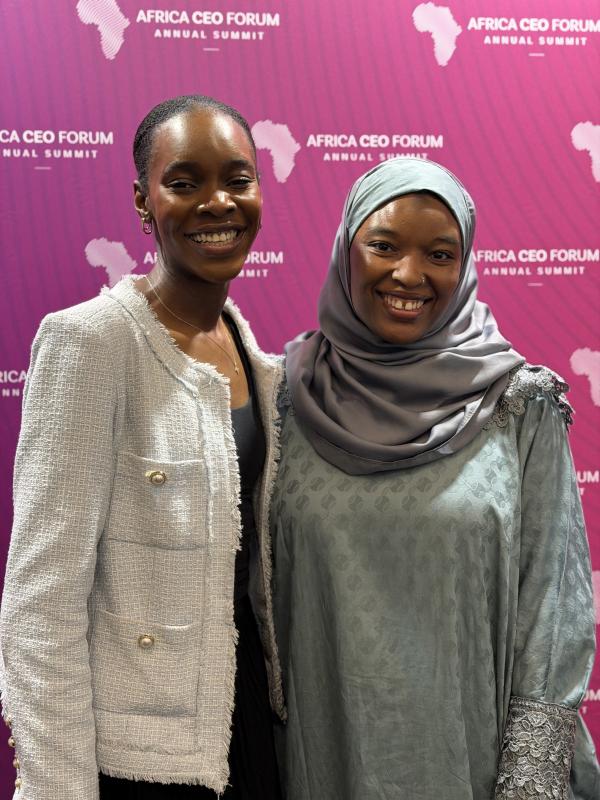
This past May, I traveled to Kigali, Rwanda to attend the Africa CEO Forum. Founded in 2012, the Africa CEO Forum remains the largest private sector convening on the African continent. As part of my role at the UN Global Compact, I organized a convening focused on harnessing the power of the African private sector to increase intra-African trade and make the AfCFTA a reality.
The African Continental Free Trade Area (AfCFTA) is the world’s largest free trade area, as defined by the number of countries involved. The ambition is, similarly, large. It aims to remove tariffs on 90% of goods, reduce barriers to trade services, and create a single continental market that has the potential to fundamentally reorder Africa’s economic geography[1]. And the potential impact is massive. According to the UN Economic Commission for Africa (ECA), full implementation of the AfCFTA by 2045 could increase Africa’s income by $450 billion and boost intra-African trade by $276 billion[2]. In terms of impact on real people, UNCTAD estimates AfCFTA implementation could lift 50 million Africans out of poverty and create 14 million jobs.[3]
Despite the enormous potential of the AfCFTA, intra-African trade remains severely limited. It has fluctuated between 15 and 21 percent of the continent’s total global trade - an incredibly low volume compared with 65% in Europe and 60% in Asia[4]. Trade in Africa has consistently fascinated and bewildered me. The continent imports so much that it can produce, for seemingly no reason. I had a few calls with the CEOs of the Africa Business Leaders Coalition last year to get their perspectives on this issue. As decision-makers on the ground operating major businesses across the continent, their perspectives were enlightening.
For some, it is perception. We ascribe a higher quality to products made in the United States or Europe, even in Africa, and often people are willing to pay a premium even though their domestic products are truly of higher quality. In other instances, it is due to the vast diversity of African countries. That diversity present in the 54 countries on the continent is beautiful, but it also presents regulatory and governmental challenges. Businesses are met with bureaucratic hurdles as they try to transport items from one country to another, with items held in ports indefinitely. Hearing all the facets of the intra-African trade problem, I realized it was an expansive and complex issue. Moreover, it would require a multi-pronged approach: we’d need participation from the governmental authorities and regulatory bodies in multiple countries, a clear roadmap for what regions to prioritize in a continental trading framework, and a departure in the “country-first” mindset that has overshadowed pan-African sentiment for years.

From these conversations, we developed a set of mindset shifts that would be required on the continent to make intra-African trade a reality. This was rooted in an understanding that there has to be a broader change within how we view and talk about intra-African trade if we want to make progress. At the Africa CEO Forum, we presented these mindset shifts and entered into a discussion on the ways the private sector can get involved[5].
This was a topic that was of particular interest to the private sector, which is why I believe there is so much potential to do good work. Intra-African trade is an economic issue that not only has major potential in the sustainability space, with its ability to create jobs and lift millions out of poverty, but it also has practical business implications, with its ability to enable authentic business growth for African companies.
As a result of this experience, I have become increasingly convinced that private sector collaboration, and private sector action will be one of the key drivers of intra-African trade. Because of the many countries in Africa, there is a large patchwork of governments and regulatory bodies at play in the intra-African trade question, and they all have varied interests and incentives that are difficult to align. Every president or prime minister wants their country to be the trade hub, or have the major port, or the critical airport. The private sector does not have such a vested interest, and are instead looking for the most efficient location for said trade hub, port, or critical airport[6]. Companies that work in multiple African markets are well-equipped to identify and advise on where we need to invest and divest our infrastructure efforts. That being said, governmental bodies are absolutely needed to protect the interests of citizens and ensure economic growth is inclusive. The ideal system I see that will be best placed to make progress on the intra-African trade problem is a sophisticated public-private partnership that incorporates the holistic perspective of the private sector and enables them to scale their work across the continent, while the public sector implements and introduces safeguards to ensure any changes are not made to the detriment of its citizens.
The Milken Family Foundation's mission is based on unlocking the power of human potential. Rather than depend on external benevolence or on traditional forms of aid, the AfCFTA's underlying logic is, at its core, a bet on African self-determination: the idea that African nations, trading with each other, can generate the growth and opportunity that external trade relationships have never fully delivered. By helping generate the private-sector insights and coalitions needed to make the AfCFTA reality, this work advances what the Milken Family Foundation has always stood for: the creation of systems and strategies that enable people and systems to realize their full productive potential, and to build lives of meaning and self-sufficiency from within.

As many different operators work to make progress on intra-African trade, my primary concern is ensuring that progress on this front focuses on ensuring inclusive business growth for African companies primarily. There are a number of multinational companies operating in Africa that are based outside of the continent, but there are also a number of homegrown African MNCs that are looking to expand their reach in the continent. Inclusive growth would ensure that intra-African trade first benefits these companies that employ and have been started by Africans.
[1] African Union Commission, "Powering Trade Through AfCFTA: A People-Driven Wholesome Development Agenda," press release, February 15, 2023, https://au.int/en/pressreleases/20230215/powering-trade-through-afcfta-people-driven-wholesome-development-agenda.
[2] United Nations Economic Commission for Africa, Economic Report on Africa 2025: Advancing the Implementation of the Agreement Establishing the African Continental Free Trade Area (AfCFTA): Proposing Transformative Strategic Actions (Addis Ababa: UNECA, April 25, 2025), https://www.uneca.org/stories/era-2025-with-effective-implementation%2C-the-afcfta-can-open-alternative-markets-to-sectors.
[3] Ecofin Agency, "Africa Has the Potential to Become a Global Trade Powerhouse, UN Report Says," February 10, 2025, https://www.ecofinagency.com/public-management/1102-46418-africa-has-the-potential-to-become-a-global-trade-powerhouse-un-report-says, reporting on United Nations Conference on Trade and Development, Economic Development in Africa Report 2024.
[4] "Intra-African Trade Under AfCFTA," GIS Reports Online, September 30, 2025, https://www.gisreportsonline.com/r/africa-trade-afcfta/.
[5] "Five Mindset Shifts to Unlock Intra-African Trade," Africa Business Leaders Coalition, UN Global Compact, 2026, https://unglobalcompact.org/library/6380.
[6] Five Mindset Shifts to Unlock Intra-African Trade.
Author(s):
