
Morocco's Cultural Identity in Relation to the African Continent
Published 03/30/2026 in Scholar Travel Stipend
Written
by Mayowa Jolayemi |
03/30/2026
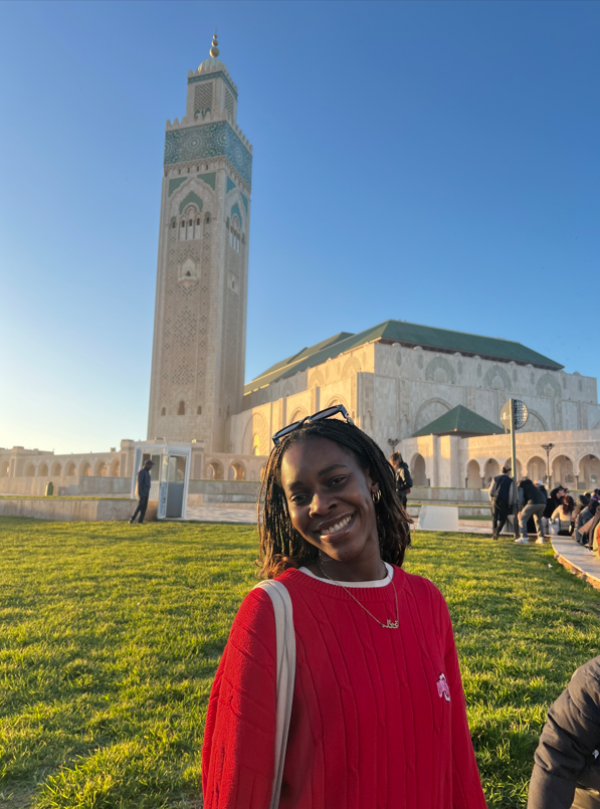
Morocco has always fascinated me. We often hear the classification “sub-Saharan Africa,” which has been political science’s nomenclature for “everything that is not North Africa.” As a Nigerian, growing up, I did not quite understand it - what was the reason we grouped North Africa as separate, when West, East, Central, and Southern Africa were lumped into one big category?
I did, however, understand that much of North Africa was happy with that classification, grateful not to be grouped with those south of the Sahara, and preferring to identify with the Arab world. And who could blame them? A unified African identity really only exists in the United States, where tribal, ethnic, and cultural differences pale in comparison to the racism and xenophobia all Africans experience daily. However, one country in North Africa has seemed more convinced of this pan-African identity and invested heavily in it: Morocco.
This was especially apparent following Morocco’s historic 2022 World Cup showing, where the Atlas Lions defeated football powerhouses Spain and Portugal to qualify for the semi-finals, making them the fourth African country ever to do so. After Moroccan National team player Sofiane Boufal dedicated the win to “all Moroccans all over the world for their support, to all Arab people, and to all Muslim people” [1], he faced widespread backlash, as much of Africa had turned to supporting Morocco following Senegal’s exit. Morocco’s head coach stepped in after this comment, saying “We want to fly Africa’s flag high just like Senegal, Ghana, and Cameroon. We are here to represent Africa,” providing a strong show of African multilateralism in the games [2].

I wanted to investigate this issue of African identity further, because it is true that football really reveals all about society. Thus, it was fitting that I traveled to Morocco as the nation hosted the biennial African Cup of Nations, as it gave me an opportunity to explore the region at a time when pan-African fervor was especially high [3]. I spent time in Casablanca and Marrakesh, two of the largest cities, to gain a deeper understanding of African cultural identity and its linkages to economic cooperation, education, and access to resources. In trying to understand the present, you inevitably confront the past, and this journey developed in me a stronger understanding of Moroccan history and how it all connects to the African continent.
First, upon my arrival in Morocco, I was greeted with a traditional musical performance at the Mohammed V International Airport, one of many features of the ongoing AFCON festivities. As I walked around Casablanca and Marrakesh, people often asked me where I was from - or abruptly (and aptly) guessed Nigeria. My qualms that my heritage and the impending Nigeria-Morocco qualifying match would make me persona non grata while there were immediately quelled as I was met with smiles and wishes of good luck for the upcoming match. “Nigeria is a great team, and we’re happy to be playing our fellow brothers,” was the basic sentiment I received as I interacted with locals. Moreover, they were proud to be hosting AFCON and representing African football. I got a stronger sense of today’s picture, particularly in the context of sports, but still wanted to understand the history to this point.
To get a more historical understanding of Morocco, I did two distinct tours; one of the major monuments and souks in Marrakesh, and another of the Atlas Mountains. Marrakesh itself is a tale of two cities - or rather, two Moroccan histories - that have converged and diverged over time into the rich tapestry of culture in Morocco today. There is a constant struggle for identity in Morocco that mirrors the nation’s own internal struggle for ownership and independence.

During my tour of the city, my tour guide, Abdul, painted a very distinct picture of Morocco. He told me of the Amazigh people, the ancient people that came from Asia and settled in Tunisia to be the initial inhabitants of North Africa. I learned how there were Jewish, Arab, Black, and Moorish Amazigh people, and how that diverse and mixed history made Moroccans more open to other cultures today [4]. When I asked him about African identity in Morocco, Abdul proudly proclaimed that Morocco was a maverick for pan-Africanism, spearheading connections with other African countries to reduce European exploitation [5]. “The greatest issue Morocco faces,” he told me, “is illiteracy. Thirty-five percent of Moroccans are illiterate, and many don’t even know they’re illiterate.” His sentiments echoed much of what I had heard from other middle-class Africans - education was the continent’s biggest issue, and if we could all just work together, we would all be better.
My conversation with Mouhammed, my tour guide for the Atlas Mountains, painted a quite different picture. For one, he taught me the term “Amazigh.” Throughout my conversation with Abdul, he referred to Imazighen as “berbers,” derived from the term “barbarian.” Mouhammed taught me that the term was offensive, and the preferred moniker, Amazigh, meant free people. I was stunned - how did I learn a whole history of a people and not get the name right? Then I learned of a whole host of societal issues faced by Imazighen, that they are not taught their native languages in schools because the kingdom of Morocco does not want them to secede and form their own country, that they are treated as second class citizens in Morocco (down to a designation on their identification cards labeling them as Amazigh), that they feel like they were conquered and colonized by the kingdom. Technically, Morocco itself was never colonized - its sultan retained status as head of state while Morocco functioned as a protectorate [6], a fact Abdul was proud to state - so I found it interesting that a country so set on anti-colonial pan-Africanism had indeed colonized a group of indigenous people.

When I asked Mouhammed his views on pan-Africanism, he laughed. “We were conquered by the Arabs,” he told me. “I don’t believe I’m anything other than African.” I was curious if Mouhammed felt the same way about the lack of education - if he thought that was what was crippling Morocco. He agreed that education was key - but he did not limit it to literacy. Rather, he focused on history. Many Africans are not aware of the resources the continent holds, how strong we can be.
It is not my place to say whether it is Abdul or Mouhammed who is correct. Indeed, like in most things, there is likely to be truth to both sides, and their perspectives do not necessarily contradict one another. But it is key to recognize perspective. While education stood at the center of both, for Abdul, an upper-middle-class tour guide working with the Four Seasons, illiteracy was a chosen barrier to progress; for Mouhammed, a low-income man from the Atlas Mountains who started a small touring program with AirBnB experiences, illiteracy was a forced reality, as the system as designed to not teach his native language. It is a reminder that, when looking at development solutions, it is key to understand how historical dynamics will impact the efficacy of the policy for different groups of people. While a widespread national literacy program in Morocco seems positive, it likely will not have meaningful uptake by the 12 million Imazighen in the country, as they have been fighting for the right to read and write in their native languages for years. Such a program will require strong messaging on how literacy can help preserve Amazigh culture and economic wellbeing to avoid it being seen as an assimilation tactic.
As someone seeking to design economic development solutions rooted in education, this experience has been a sobering reminder to me that class, income, and ethnic background can completely change what solutions work for whom. Furthermore, I am even more aware of the interdependencies that exist in economic development - education solutions alone will not be as powerful unless deployed in tandem with the social and financial tools necessary to make educational policy viable.
Citations:
1 “Morocco’s Boufal Clarifies World Cup Victory Dedication After African Backlash,” Bladi.net, December 2022, https://en.bladi.net/morocco-boufal-clarifies-world-cup-victory-dedication-african-backlash%2C98389.html/
2 “How Morocco’s Atlas Lions Made History at the 2022 World Cup,” Global Voices, December 27, 2022, https://globalvoices.org/2022/12/27/how-moroccos-atlas-lions-made-history-at-the-2022-world-cup/
3 “In Morocco, Football Is Also a Diplomatic Game,” Le Monde, February 6, 2025, https://www.lemonde.fr/en/le-monde-africa/article/2025/02/06/in-morocco-football-is-also-a-diplomatic-ga me_6737838_124.html/
4 Asmae Essafar, “Amazigh Heritage in Morocco: History, Language, and Identity,” BlueskyMorocco, 2025, https://www.blueskymorocco.com/amazigh-culture-morocco/
5 “The Meaning of Morocco’s Return to the African Union,” Africa Portal, 2023, https://africaportal.org/wp-content/uploads/2023/05/Meaning_of_Moroccos_Return.pdf/
6 Morocco: Decline of Traditional Government, 1830–1912, in Morocco (Encyclopædia Britannica), accessed Feb 5, 2026, https://www.britannica.com/place/Morocco/Decline-of-traditional-government-1830-1912/
Author(s):
