
Lessons from Ghana: Building a More Integrated Africa
Published 06/03/2026 in Scholar Travel Stipend
Written
by Gumana Elrufai |
06/03/2026
As the African Union reassesses the implementation of the Kampala Convention – a treaty that addresses internal displacements caused by conflict, natural disasters, and development projects in Africa – I came to realize that our actions today in the status quo are critical opportunities to elevate the African Commission on Human and Peoples’ Rights’ (ACHPR) role in ensuring displaced individuals are not only protected but fully integrated into the societies in which they now reside. Ultimately, empowering the ACHPR to play a more active role in overseeing integration will contribute to building a more inclusive, unified, and rights-protecting continent. This task is not just a legal obligation; it is a moral imperative.
This issue is especially urgent given the scale and simultaneity of current displacement crises. Since April 2024, the Sudanese civil war has displaced over 10 million people, many of whom have crossed borders into Chad, South Sudan, Ethiopia, and Egypt, placing enormous strain on host states with already limited infrastructure.1 Estimates indicate that up to 40 million Africans are forcibly displaced, the overwhelming majority of whom are internally displaced persons (IDPs).2 However, as of 2023, only 24 of 55 AU members had enacted legislation or policies explicitly aligned with the Kampala Convention, and no continental mechanism exists to ensure uniform implementation.3
Growing up as a Sudanese immigrant in NYC, I always felt attached to Sudan, as I was born there and the majority of my family resided in the country. Going into high school and even now as a college student, I have always been interested and very aware of the conflicts, atrocities, and human rights violations that happened within the country’s borders. To me, this was not an issue that I watched from afar on the news or read about in papers, but became a daily cause of worry as I had phone calls with cousins, aunts, and uncles. They explain how not only were they attempting to escape war, but also their lives as Sudanese refugees in Egypt, Kenya, the UAE, etc. This became my everyday worry: how could our international institutions help mitigate the issues that my family is so heavily affected by?
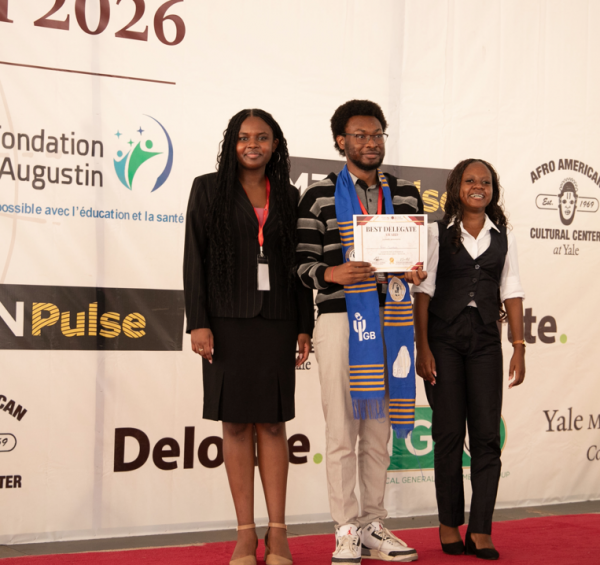
I began to research institutions like the International Criminal Court and the African Union, and read up on the United Nations’ stance on what my people were suffering through. However, I began to see the gaps in our anarchical world order that have not yet been filled. This interest drew me to participate in Yale’s Model African Union as Co-USG of delegate recruitment, where I not only helped plan a model African Union conference with over 400 delegates from all over the continent but also chaired the African Commission of Human and Peoples’ Rights committee.
 Through this role, I began to research the African Union’s stance on such human rights violations and began to understand what was lacking. As I chose a topic for our committee, I noticed a repeated pattern where countries were agreeing to certain standards, but the problem became salient when each country did not adhere to or make active efforts to mitigate issues. Hence, within my committee, our topic and resolution focused on the States Integration of Displaced People Within the African Continent. With the influx of displaced people, many countries have heightened discriminatory procedures. Delegates were asked to create a plan for the ACHPR to recommend to its member states to help create easier integration. Whether that be a passage for citizenship, easier access to documentation, etc, delegates could come with solutions for measuring and reporting states' compliance with specific laws in order to measure how well certain policies are working.
The specific lens through which our ACPHR committee analyzed the issue revolved around the rights of refugees, internally displaced persons (IDPs), and stateless people when it comes to integration passageways provided by state actors. Delegates drafted a resolution that strengthens the ACHPR’s role and ability in monitoring the human rights of displaced populations. So within this committee, the specific focus is on integration law and policy within different African states. Delegates were also asked to consider the actual application of said proposals. This included partnering with different civil society organizations, regional bodies, international organizations, etc., to ensure and enhance the monitoring and implementation of proposed solutions.
Through my research prior to the conference, I thought that I had achieved a grasp of what the real issues with the ACPHR were; however, as the 40 delegates in my committee session started presenting their ideas and resolutions, I viewed the issue completely differently. These delegates, aged 16-25, from all over Africa, had different concepts of what true integration meant. One delegate, a refugee from South Sudan, claimed that “there could not be true integration without solutions to the pre-existing problems within these host countries.” Explaining that proper infrastructure needed to be built, and the poor refugee conditions, a lack of integration were entrenched by the host countries’ lack of institutions to provide health care, education, and social support to their own citizens, let alone incoming refugees.
Other delegates disagreed with this take and explained that in countries like Egypt, where most of my family now resides, there is a gap in support towards displaced people and host countries' capacities of economic, social, and political rights.
Each delegate brought their own and unique understanding to the issue, despite the conflicting understandings, all 40 delegates voted on a resolution which our team submitted to the African Union Youth Committee for consideration. One clause written by the delegates included “Addressing one of the root causes of displacement by demanding investment in climate-adaptive infrastructure and disaster risk reduction through focusing on areas, but not limited to: Early warning systems, Flood mitigation projects, Climate-smart agricultural training for vulnerable households.”4 This clause in particular helped mitigate the issue of displacement itself and furthered that goal.

Delegates agreed on a sustainable fund that shall be established to ensure increased investment in education, healthcare, and social protection systems to improve living conditions and reduce socio-economic inequalities that often drive displacement, which would be financed through individual and national donations, as well as a mandatory tax system that shall be established by member states to contribute towards.
When it came to the effects of displacement, we also reached a conclusion in allowing those who are already displaced to receive better conditions. They called upon all states to provide full freedom of movement to displaced persons within their territories to enable them access to healthcare, education, employment, and recreational services. They also emphasized the importance of documentation systems across host nations being digitalized to enable accurate tracking and monitoring.
 Although this conference was a simulation, participating as an organizer and chairing my committee had very real effects on not only the delegates' and my understanding of this issue, but also moved us one step closer to tackling a critical global issue, which the Milken Institute and Foundation supported my work towards. Being in a room where I heard these delegates discuss a topic so close to home truly helped me understand the capacity for change and innovation that is possible when it comes to integration and displacement prevention. Delegates’ resolutions were also sent to the African Union Youth Commission for consideration. Their ideas not only reflected a Pan-African compromise but also reached the desks of the policymakers responsible for making these decisions.
References:
1 Eldin, Ahmed Gamal. 2025. “Forgotten and Neglected, War-Torn Sudan Has Become the World’s Leading Displacement Crisis.” Migrationpolicy.org. July 14, 2025. https://www.migrationpolicy.org/article/sudan-civil-war-displacement.
2 “What Happens in Africa Stays in Africa (Mainly).” 2025. Wilson Center. January 14, 2025. https://www.wilsoncenter.org/blog-post/what-happens-africa-stays-africa-mainly.
3 “Cross-Regional Forum on Implementing Laws and Policies on Internal Displacement in Africa SUMMARY NOTE.” 2024.
https://globalprotectioncluster.org/sites/default/files/2025-01/cross_regional_forum_24_-_eng.pdf.
4 “UNHCR Highlights Forced Displacement Trends, Protection Risks, and Solutions in West and Central Africa | UNHCR Africa.” 2020. UNHCR Africa. 2020.
https://www.unhcr.org/africa/news/press-releases/unhcr-highlights-forced-displacement-trends-protection-risks-and-solutions-west.
Author(s):
