
Lessons From Colombia
Published 12/11/2025 in Scholar Travel Stipend
Written
by Chase Lin |
12/11/2025
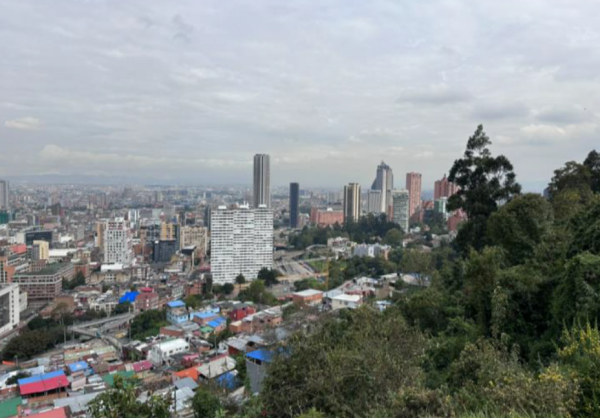
When my plane landed in Bogotá, I wasn’t sure what to expect. I had come to Colombia hoping to understand the local culture and societal infrastructure. What I discovered was how young people find purpose when opportunity is scarce, and what structures help them stay in school. What I discovered over the next two weeks, traveling from Bogotá to Medellín to Cartagena, went far beyond classrooms. My discoveries ranged from observations of the walls of the city, the rhythm of its streets, and in the choices people make when life demands creativity to survive.
When my plane landed in Bogotá, I wasn’t sure what to expect. I had come to Colombia hoping to understand the local culture and societal infrastructure. What I discovered was how young people find purpose when opportunity is scarce, and what structures help them stay in school. What I discovered over the next two weeks, traveling from Bogotá to Medellín to Cartagena, went far beyond classrooms. My discoveries ranged from observations of the walls of the city, the rhythm of its streets, and in the choices people make when life demands creativity to survive.
In Bogotá, the first thing that struck me wasn’t the skyline or the traffic: it was the art and graffiti. Every corner pulsed with color and meaning. Murals stretched across entire buildings, telling stories of resistance, hope, and memory. At first, I thought it was simply street art; then I learned that much of it was government-sponsored (“Distrito Grafiti”; “El grafiti en Bogotá 2024”). One of the most compelling examples is Bogotá’s Distrito Grafiti, a formally recognized street-art district operated by the city’s Instituto Distrital de las Artes (IDARTES). Rather than treating graffiti simply as vandalism, local government has created legal walls, organized artist calls, and institutionalized a “graffiti board” to steward public art. According to official Bogotá city communications, the Distrito Grafiti has become a platform to “transform social realities through color, creativity … and inclusion based on free expression.” In August 2024, the Secretary of Culture (Cultura y Deporte) published a piece titled El grafiti en Bogotá: de arte subterráneo a movimiento social, celebrating how street art has grown into a socially embedded movement. The city had found a way to channel youth expression into something powerful—art as civic education. Local students I spoke with explained how public art programs had become an alternative to joining cartels, which still recruit aggressively in low-income neighborhoods. By legitimizing graffiti, Bogotá didn’t just beautify its streets; it built a cultural ecosystem where creativity offers belonging and purpose (“Graffiti District: Colorful Walls That Tell Stories”).

One artist I met through my tour guide told me, “Before, people like me would disappear into gangs. Now, we disappear into our walls.” His mural, depicting a child planting a pencil instead of a gun, felt like a manifesto. I realized how social policy could use art as a quiet form of education. In a city where formal schooling often competes with survival, street art itself becomes a classroom. More concretely, a 2023 diagnostic report by the city found that Bogotá supports Local Graffiti Tables (“Mesas Locales de Grafiti”) across multiple boroughs (localidades), from Ciudad Bolívar to Kennedy, which help channel community mural projects, youth participation, and organized moralization. These kinds of formal structures demonstrate that Bogotá is not just tolerating graffiti — it is giving it institutional legitimacy and co-governance.
As I left the city center, the contrast became starker. Driving toward the outskirts, glass towers gave way to brick homes, then tin roofs. The wealth inequality was impossible to miss. Some areas are still shack towns, versus others rapidly evolving skyscrapers. It reminded me that access to opportunity in Colombia wasn’t just about schools, but whether a family had the resources to handle the opportunity cost. Education is never only about schools—it’s about whether a child’s family can afford not to send them to work. Colombia’s economic divide makes that choice painfully visible (“OECD Economic Surveys: Colombia 2024”; “Poverty & Equity Brief: Colombia”).
In Medellín, I saw another layer of that story. Once known for cartel violence, the city has transformed itself through innovation and community investment. I took a cable car up into the hillside barrios—neighborhoods that were once unsafe to enter but now brim with murals, music, and youth centers. My guide explained how the government intentionally built the metro and cable car system to integrate marginalized communities into the city’s economy and education infrastructure (“Comuna 13, Medellín”). Public transit became a bridge—literally—to opportunity.
It was in one of those hillside libraries, built as part of Medellín’s “social urbanism” projects, that I saw a group of teenagers working on an after-school program. My tour guide explained how easy it still is for students to be drawn into organized crime—how the promise of quick money can overshadow long-term dreams. However, he also shared how programs offering mentorship, art, and vocational skills helped them imagine futures outside of the cartel’s shadow (“How Graffiti Improves Lives”). Graffiti and street art in Comuna 13 are deeply interwoven with this infrastructure. Local artists — including well-known figures like Chota_13 — have used public walls, pedestrian walkways, and gathering spaces to narrate the history of violence, displacement, and renewal. Today, community-led graffiti tours (Graffitour) draw thousands of visitors every month, turning art into an engine for social tourism, local economic development, and intergenerational memory work. This artistic and infrastructural transformation emerges amid broader structural inequalities in Colombia — inequalities that recent data show remain stubborn. According to a 2024 World Bank report, more than 16 million Colombians still live in poverty, and disparities in public service access (like education and health) are deeply territorial: many municipalities lag far behind in school quality, formal employment, and institutional presence (World Bank 1). Regional gaps are so severe that at least 30 percent of labor income inequality is tied to “circumstances at birth.” A 2024 OECD Economic Survey of Colombia underscores the same point: while school enrollment has generally improved, educational outcomes remain strongly stratified by socio-economic background (OECD 1). According to the OECD’s Education at a Glance report, a high share of lower-secondary students in Colombia are “at least two years older than the expected age for their grade” — a marker of persistent educational lag tied to inequalities.

When my plane landed in Bogotá, I wasn’t sure what to expect. I had come to Colombia hoping to understand the local culture and societal infrastructure. What I discovered was how young people find purpose when opportunity is scarce, and what structures help them stay in school. What I discovered over the next two weeks, traveling from Bogotá to Medellín to Cartagena, went far beyond classrooms. My discoveries ranged from observations of the walls of the city, the rhythm of its streets, and in the choices people make when life demands creativity to survive.
In Bogotá, the first thing that struck me wasn’t the skyline or the traffic: it was the art and graffiti. Every corner pulsed with color and meaning. Murals stretched across entire buildings, telling stories of resistance, hope, and memory. At first, I thought it was simply street art; then I learned that much of it was government-sponsored (“Distrito Grafiti”; “El grafiti en Bogotá 2024”). One of the most compelling examples is Bogotá’s Distrito Grafiti, a formally recognized street-art district operated by the city’s Instituto Distrital de las Artes (IDARTES). Rather than treating graffiti simply as vandalism, local government has created legal walls, organized artist calls, and institutionalized a “graffiti board” to steward public art. According to official Bogotá city communications, the Distrito Grafiti has become a platform to “transform social realities through color, creativity … and inclusion based on free expression.” In August 2024, the Secretary of Culture (Cultura y Deporte) published a piece titled El grafiti en Bogotá: de arte subterráneo a movimiento social, celebrating how street art has grown into a socially embedded movement. The city had found a way to channel youth expression into something powerful—art as civic education. Local students I spoke with explained how public art programs had become an alternative to joining cartels, which still recruit aggressively in low-income neighborhoods. By legitimizing graffiti, Bogotá didn’t just beautify its streets; it built a cultural ecosystem where creativity offers belonging and purpose (“Graffiti District: Colorful Walls That Tell Stories”).
One artist I met through my tour guide told me, “Before, people like me would disappear into gangs. Now, we disappear into our walls.” His mural, depicting a child planting a pencil instead of a gun, felt like a manifesto. I realized how social policy could use art as a quiet form of education. In a city where formal schooling often competes with survival, street art itself becomes a classroom. More concretely, a 2023 diagnostic report by the city found that Bogotá supports Local Graffiti Tables (“Mesas Locales de Grafiti”) across multiple boroughs (localidades), from Ciudad Bolívar to Kennedy, which help channel community mural projects, youth participation, and organized moralization. These kinds of formal structures demonstrate that Bogotá is not just tolerating graffiti — it is giving it institutional legitimacy and co-governance.
As I left the city center, the contrast became starker. Driving toward the outskirts, glass towers gave way to brick homes, then tin roofs. The wealth inequality was impossible to miss. Some areas are still shack towns, versus others rapidly evolving skyscrapers. It reminded me that access to opportunity in Colombia wasn’t just about schools, but whether a family had the resources to handle the opportunity cost. Education is never only about schools—it’s about whether a child’s family can afford not to send them to work. Colombia’s economic divide makes that choice painfully visible (“OECD Economic Surveys: Colombia 2024”; “Poverty & Equity Brief: Colombia”).
In Medellín, I saw another layer of that story. Once known for cartel violence, the city has transformed itself through innovation and community investment. I took a cable car up into the hillside barrios—neighborhoods that were once unsafe to enter but now brim with murals, music, and youth centers. My guide explained how the government intentionally built the metro and cable car system to integrate marginalized communities into the city’s economy and education infrastructure (“Comuna 13, Medellín”). Public transit became a bridge—literally—to opportunity.
It was in one of those hillside libraries, built as part of Medellín’s “social urbanism” projects, that I saw a group of teenagers working on an after-school program. My tour guide explained how easy it still is for students to be drawn into organized crime—how the promise of quick money can overshadow long-term dreams. However, he also shared how programs offering mentorship, art, and vocational skills helped them imagine futures outside of the cartel’s shadow (“How Graffiti Improves Lives”). Graffiti and street art in Comuna 13 are deeply interwoven with this infrastructure. Local artists — including well-known figures like Chota_13 — have used public walls, pedestrian walkways, and gathering spaces to narrate the history of violence, displacement, and renewal. Today, community-led graffiti tours (Graffitour) draw thousands of visitors every month, turning art into an engine for social tourism, local economic development, and intergenerational memory work. This artistic and infrastructural transformation emerges amid broader structural inequalities in Colombia — inequalities that recent data show remain stubborn. According to a 2024 World Bank report, more than 16 million Colombians still live in poverty, and disparities in public service access (like education and health) are deeply territorial: many municipalities lag far behind in school quality, formal employment, and institutional presence (World Bank 1). Regional gaps are so severe that at least 30 percent of labor income inequality is tied to “circumstances at birth.” A 2024 OECD Economic Survey of Colombia underscores the same point: while school enrollment has generally improved, educational outcomes remain strongly stratified by socio-economic background (OECD 1). According to the OECD’s Education at a Glance report, a high share of lower-secondary students in Colombia are “at least two years older than the expected age for their grade” — a marker of persistent educational lag tied to inequalities.
Faith is another quiet force that shapes these communities. In every city I visited, the church stood as both anchor and gatekeeper. Sunday mornings, entire families filled plazas, spilling out from the doors of centuries-old cathedrals. The church provides stability and moral guidance, but it also defines what conversations are permissible in schools and public discourse. In rural areas especially, education and religion are inseparable; what’s taught often depends on what’s blessed. I saw how this balance, between tradition and progress, affects what students are encouraged to question, and what remains off-limits.

In Cartagena, I wandered through markets that felt like open-air classrooms in their own right. From grand shopping malls to street vendors stacked with fruit or trinkets, every transaction was a lesson in economics, trust, and ingenuity. Street markets bustled with the energy of informal entrepreneurship. I watched vendors teach their children how to count change, haggle, and read the flow of customers. In a society where formal employment is uncertain, these markets serve as living examples of practical education: where survival skills and creativity intertwine.
There’s an abundance of pushcarts in Colombia. The benefit of these carts is that they extend the outreach of vendors beyond geographical constraints. However, carts didn’t just sell merchandise, they also sold messages. I saw one cart that advocated for adopting pets rather than purchasing them. This made me contemplate how information dissemination could work in Colombia and other countries where access to internet and technology isn’t as readily available.

Across all three cities, I saw a country that wrestles daily with inequality yet refuses to let it define its spirit. I also saw how resilience—formal or informal, institutional or improvised—runs through every part of life. Whether through graffiti walls, community libraries, church gatherings, or market stalls, learning persists. People teach and learn wherever they can.
As I reflected on these experiences, I realized how much they connect to my own mission. At Stanford GSB, I’m studying how to design systems that make education more accessible worldwide. Colombia reminded me that education is never just a policy—it’s a cultural negotiation. It requires understanding the forces that pull young people away from learning, and the local solutions that pull them back. Graffiti art, mentorship programs, faith networks, and street markets are all part of that ecosystem.
This trip helped me see that expanding education access means meeting students where they are physically, economically, and emotionally. It’s not just about building schools but about strengthening the social structures that make learning possible. That insight will guide my work as I continue to explore how we can scale education access globally, especially in communities that face the same challenges I saw across Colombia.
My journey through Colombia taught me that education is not only about what happens inside classrooms: it’s about the creativity, resilience, and humanity that exist far beyond them.
Works Cited
“Comuna 13, Medellín.” *Wikipedia*, https://en.wikipedia.org/wiki/Comuna_13,_Medell%C3%ADn
“Distrito Grafiti.” *IDARTES*, www.idartes.gov.co/es/areas-artisticas/artes-plasticas-y-visuales/distrito-grafiti
“El grafiti en Bogotá 2024.” *Secretaría de Cultura, Recreación y Deporte*, https://culturarecreacionydeporte.gov.co/es/principal/noticias/el-grafiti-en-bogota-2024
“Graffiti District: Colorful Walls That Tell Stories.” *Visit Bogotá*, https://visitbogota.co/en/blog/all/graffiti-district-colorful-walls-that-tell-stories-all-4101
“How Graffiti Improves Lives.” *Meeting of Styles*, https://meetingofstyles.com/comuna-13-how-graffiti-improves-the-lives-of-people-around-it/
“OECD Economic Surveys: Colombia 2024.” *OECD*, www.oecd.org/content/dam/oecd/en/publications/reports/2024/09/oecd-economic-surveys-colombia-2024_7b382d76/a1a22cd6-en.pdf
“Poverty & Equity Brief: Colombia.” *World Bank*, documents1.worldbank.org/curated/en/099548304212535449/pdf/IDU-3d0ab3ad-59de-4f46-9a37-d89ee2a5ea44.pdf
“Report on Poverty Trajectories in Colombia.” *World Bank*, www.worldbank.org/en/country/colombia/publication/informe-trayectorias-prosperidad-y-reducci-n-de-la-pobreza-en-el-territorio-colombiano
Author(s):
