
Indigenous Cultural Persistence in the St. Thomas, U.S. Virgin Islands
Published 05/18/2026 in Scholar Travel Stipend
Written
by Amanda Cisse |
05/18/2026
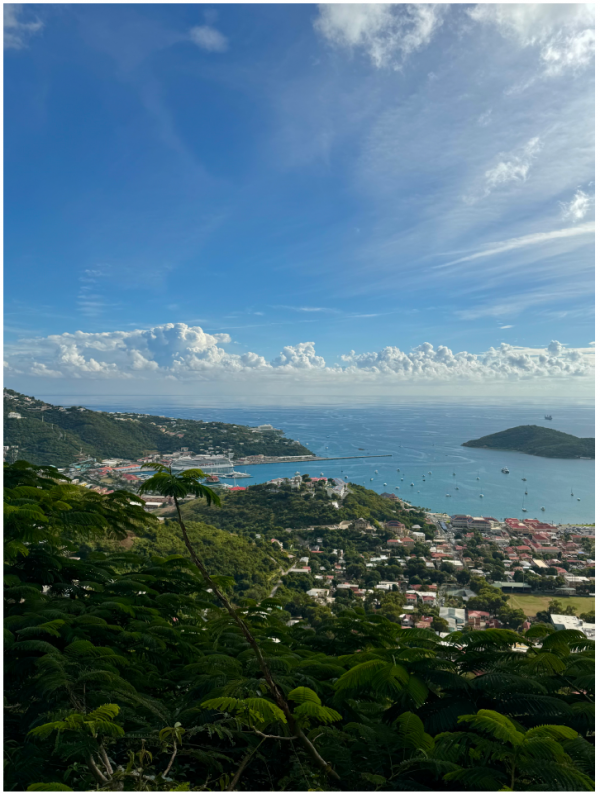
My inspiration in visiting St. Thomas comes from my own indigenous background with the Susu tribe of Guinea. As I see modern culture and Guinean tradition carry through in my own life through music, food, clothing, dance, and more, I wanted to visit and connect with another indigenous community close to the U.S.
I hoped to experience indigenous culture and traditions through local residents directly, because I believe that the most meaningful way to understand culture is through the people who live it. With this trip I aimed to look past the centering of European and North American cultures in our education system, as Indigenous and non-European cultures are often excluded from dominant historical narratives.
When I arrived in St. Thomas, I walked through Charlotte Amalie’s Main Street expecting to find a mix of cultural space. I instead encountered rows of diamond stores catering primarily to tourists. After visiting Main Street and other popular destinations like Magen’s Bay and Sapphire beach, I felt that the space was overwhelmed with cruise ship visitors and tourist shops. If Indigenous and local cultures were not immediately visible in popular or tourist spaces, I attempted to actively seek them out through conversation and exploration.
Through a combination of academic research, visits to cultural sites, and five in depth conversations with indigenous residents, I learned that the Indigenous cultural identity in St. Thomas persists throughout the island through creolized cultural forms, especially in music, craft, and everyday social practices.

Across the Virgin Islands, the main Indigenous group is associated with the Taino people, who inhabited the Caribbean prior to European colonization. While I had never learned of Taino culture in school, further research shows that it is far from lost: “Taíno culture did not simply vanish but persisted in altered forms among surviving populations” (Rouse, 1992). Similarly, scholars Keegan and Carlson emphasize that cultures in the Virgin Islands are “products of long-term interaction rather than disappearance” (Keegan & Carlson, 2008). This process is called creolization, where Indigenous Taino, African, and European cultures combine together over the decades to form new cultural identities. As Mimi Sheller explains, Caribbean culture is shaped by “entangled histories of conquest, resistance, and cultural exchange” (Sheller, 2003).
On St. Thomas, the clearest example to me of this continuity was music. Along the beach and in local restaurants, I often heard the banjo and squash in Quelbe music, the official folk music of the Virgin Islands. Quelbe has served as both a form of storytelling for indigenous communities in St. Thomas, and even “served as a vehicle for transmitting news, gossip, and social commentary” (de Jongh, 2001) It often includes “satirical commentary and coded language that reflect the lived experiences of the community” (2001). Quelbe also relies on linguistic nuance, with influences from French and Patois to convey meaning. I also visited a local Zouk and Bouyon live band, which played a very high energy and fast paced style of music that originates from the African traditions of call and response. As indigenous locals described in St. Thomas, the genres of Bouyon, Quelbe, and Zouk music all align with island traditions of storytelling and respect towards elders and historical tradition. I was touched by the interconnectedness of African and Caribbean cultures, and the way indigenous music in St. Thomas functions as a living archive that allows for cultural continuity across time, across different islands, and even entirely different continents.
I spoke with several indigenous residents while exploring the island, including locals working in entertainment and cultural spaces. One conversation that stood out to me was with a local who described the difficulty of creating spaces that reflect indigenous culture due to the tourism industry. He spoke of dreaming to open an entertainment center that focused on St. Thomas culture in Downtown Charlotte Amalie, but felt unable to fulfill his wish due to tourist shops, diamond stores, and high rent and property tax. Learning about his experiences furthered my understanding of the importance of the preservation of Indigenous and local identity through lived practice rather than popular destinations or institutions.
I explored indigenous culture in St. Thomas in Frenchtown, a historic and less commercialized neighborhood that was historically settled by immigrants from the French Caribbean, particularly St. Barthélemy. I visited smaller shops and markets where artists sold handmade jewelry indigenous to St. Thomas and patterned clothing. They stood in contrast to more mass-produced and reified goods produced on Main Street that I found when I first visited. In the markets in Frenchtown, I was surrounded not only by French speakers but pidgins like Virgin Islands Creole and French based patois, reminding me of the importance of language both in music and in culture. Linguists note that many Caribbean creole languages emerge from contact between African, European, and Indigenous populations, becoming mainstream languages across the islands (Holm, 2000). This reinforces the idea that indigenous cultures on St. Thomas were not always visibly expressed in crowded locations, but rather embedded through community traditions and creations such as music, craft, and language.

As I reflected throughout the trip on my own Indigenous background, I was inspired by the strong presence of Indigenous culture in St. Thomas. It gave me hope for indigenous culture in Guinea, and challenged thinking that indigenous culture is trending towards erasure. While not always prominently on display or formally recognized, I was able to understand how important it is for the culture to be lived and sustained through music, craft, storytelling, and daily interactions.
Some of my most valuable educational experiences have not been taught in school. I have learned throughout my life and through the way I was raised to think critically about what exactly I am taught in the classroom, and to supplement with learning outside of the classroom. By visiting St. Thomas and intentionally learning about its indigenous communities, I have continued to become a lifelong leader for a better world who values lifelong learning as well. Informed by my own personal experiences, I know I will become the type of policy maker who centers local communities, cares less about the titles, and more about the problems I will solve.
References
de Jongh, J. P. (2001). Virgin Islands folk music: Quelbe and the cultural tradition. University of the Virgin Islands Press.
Health Resources & Services Administration. (n.d.). U.S. Virgin Islands health workforce and economic overview. https://mchb.tvisdata.hrsa.gov/Narratives/Overview/6fbf534a-40bb-438c-8b33-e42050325a64/
Holm, J. (2000). An introduction to pidgins and creoles. Cambridge University Press.
Keegan, W. F., & Carlson, L. A. (2008). Talking Taíno: Caribbean natural history from a native perspective. University of Alabama Press.
Moody’s Analytics. (n.d.). U.S. Virgin Islands economic indicators. ttps://www.economy.com/us-virgin-islands/indicators/
Realtor.com (2025). St. Thomas housing market trends. https://www.realtor.com/local/market/virgin-islands-of-the-united-states/st.-thomas-county/saint-thomas/
Rouse, I. (1992). The Taínos: Rise and decline of the people who greeted Columbus. Yale University Press.
Sheller, M. (2003). Consuming the Caribbean: From Arawaks to zombies. Routledge.
St. Thomas Source. (2025, January 8). USVI sets new tourism records and cruise passenger arrivals. https://stthomassource.com/content/2025/01/08/usvi-sets-new-tourism-records-solidifies-position-as-top-caribbean-destination/
Author(s):
