
Guangzhou, Taipei, and Seoul: Recognizing the Politics and Remembering the People
Published 03/23/2026 in Scholar Travel Stipend
Written
by Karen Li |
03/23/2026
China, Taiwan, Korea. I had been to each of these three places in the past and recently had the opportunity to revisit all of them within the span of two weeks. While eating my way through Guangzhou’s 荔湾区 (LiWan District), hiking in Taiwan’s 阿里山 (Alishan), and shopping in Seoul’s Myeondong-gil, I thought about how all three of these regions are constantly mentioned in our mainstream news because of the roles they play in global politics and economics. But while there, I saw how important it is to also remember the people on the ground.
One aspect of the Milken Institute's mission is developing “blueprints for tackling some of our most critical global issues through the lens of what’s pressing and what’s coming next,” so during my travels, I wondered how each of these governments addresses its own history while also fostering a sense of nationalism in its people to tackle global issues. However, during this trip, I also aimed to learn more about the “advance inventive, effective ways of helping people help themselves and those around them lead productive and satisfying lives,” an integral part of the Milken Family Foundation’s mission statement, by observing communities through a more personal lens, not just as political bodies.
Differing blueprints
The first stop on my trip was Guangzhou, China. During this visit, one of the most memorable landmarks we visited was 沙面岛 (ShaMianDao Island).
沙面岛 was a fascinating physical embodiment of east meets west and a representation of how China both preserves and lets go of its past. While walking through 沙面岛, I was struck by how well preserved the Western-style was, considering many of the structures were built by Europeans when China lost control of the region during the Opium Wars [1]. As we passed by the apartment houses, my mother explained how the government renovated the fronts of those buildings, free of charge to its residents, to make their façades nicer for tourism. They also preserved the cannons meant to protect the region from those who wanted to conquer it.
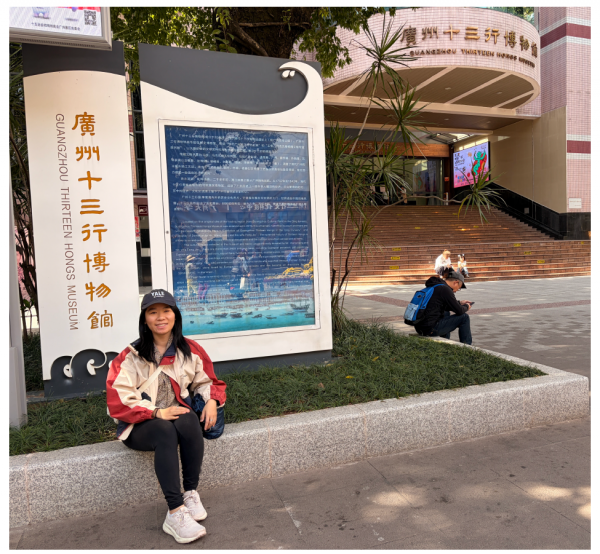
 However, when we arrived at the bridges connecting the island to the mainland, my mother pointed out that when the Europeans had control of this island, they had put up signs saying that Chinese people and dogs (with both parties put in the same category) were not welcome on the island. I did not see any of those signs preserved as I walked across the bridges, understandably so. I continued to think about the selective preservation of memories as we headed to 广州文化公园 (Guangzhou Cultural Park). There, we visited the 十三行博物馆 (Shisanhang Museum) which displayed some of the important artifacts showcasing the success of the port for foreign trade in ancient China. The museum discussed the Opium Wars but did not focus on them, rather focusing on the importance of the region for global trade. It was interesting to note how China, like any other country, focuses on its strengths not its weaknesses in its preservation of its history, undoubtedly to drive its people to continue rising in the global world stage.
The standardization of language is another piece of the blueprint that China has for strengthening its sense of nationalism among its people in order to lift itself up on the global world stage. A decade ago when I was last in Guangzhou, Cantonese was the default language, but now, Mandarin is more of the default. The Chinese government has been pushing forth standardized Mandarin language across the country, so dialects like Cantonese must rely only on families and communities to pass the language along to future generations [2]. For me, this was sad to notice, especially as someone who grew up speaking Cantonese in my own household. 
After Guangzhou, we traveled to Taipei, Taiwan which has its own unique history of colonization. We stayed in 西門町 (XiMenDing), which is similar to Times Square in New York, and there, I saw firsthand the historical and continued foreign influences in Taiwan. For example, one of the most prominent buildings in the neighborhood is called 西門紅樓 (XiMenHongLou, The Red House), which was built by the Japanese when they colonized Taiwan. It has now become a historical landmark and cultural house. I also saw foreign influences at their 7/11 stores (which are much more than convenience stores, akin to hubs for food, essentials, delivery, and even banking). Many 7/11 stores had themes, some with ties to famous characters such as Hello Kitty/Sanrio and Snoopy/Peanuts, others with ties to brands such as Lays. These were physical embodiments of how Taiwan interweaves foreign influences into its businesses.
For Taiwan, especially in Taipei, foreign influences are not weaknesses, but rather strengths. Taiwan does not shy away from its history of colonization, rather taking pride in being “the heart of Asia.” Conversations about Taiwan are usually debates about whether or not Taiwan belongs to China [3], but anyone who visits can see that the answer is not so simple. The people have embraced foreign influences, taking the best parts of Chinese, Japanese, and Western cultures and combining them with their indigenous Taiwanese cultures to create a sense of identity and nationalism that is uniquely Taiwanese. This is an integral part of Taiwan’s blueprint for tackling global challenges. 
After Taipei, we traveled to Seoul, South Korea where its sense of nationalism is fueled by its history of war. The most prominent sight one might see while walking through Seoul is young men in their military uniforms. South Korean men are required to perform compulsory military service for around 2 years and must enlist at or before they turn 284. Seeing the Korean military uniform everywhere seems to evoke a fundamental sense of pride for the national identity. This pride was also a highlight of the National Museum of Korea. One of the most memorable exhibits at the museum was about Korean athletes who made history on the world stage. They highlighted Son Kee Chung who won gold in the marathon at the 1936 Berlin Olympics. They emphasized how at the time, Korea was under Japan occupation so he was required to compete as a member of the Japanese delegation, but Son Kee Chung outwardly showed Korean pride, signing his name in Korean and refusing to acknowledge the Japanese anthem and flag during his award ceremony.
This nationalism is also shown in the reconstructed palaces across Seoul. There were many preserved palace grounds that all visitors could walk through and learn more about Korean history. At Gyeongbokgung Palace, they showcase a changing of the guard ceremony twice a day featuring people in traditional guard outfits from the era of dynasties. There, the government aims to preserve a culture that is fundamentally Korean. That is Korea’s blueprint for how the nation aims to protect itself and tackle any upcoming global challenges.

Across Guangzhou, Taipei, and Seoul, formation of national identity looks different, reflecting their differing histories and roles on the global stage. And yet, for the people themselves, living a meaningful life looks strikingly similar.
Meaningful Living
I recently watched a video by Jaeki Cho, founder of Righteous Eats, that reminded me of the importance of focusing on the people behind the idea. In this video, he emphasized that we turn places like Taiwan “into concepts, chess pieces, statistics, but these aren’t abstractions. These are neighborhoods, families...”[1]. China, Taiwan, and Korea often appear in western media but mainly in the context of global politics and economics. Rarely do those conversations acknowledge the people living their day-to-day lives. Thus, I aimed for my trip to be more than just observations of how the countries tackle global issues; I wanted to also focus on how the people themselves “lead productive and satisfying lives.” 
Guangzhou reaffirmed for me that the greatest joys in life are not necessarily considered luxurious. Many of the best food places were simple stalls, with people lining up for half an hour to an hour to eat. Some were simple, tiny places with only a few workers, like a rice noodle place with only a husband and a wife preparing 3 menu items in a 12’ x 12’ stall. The open air markets featured groceries and essentials of all kinds, with some older “aunties and uncles” selling fresh durian, others selling eggs from all kinds of birds, vendors selling pajama pants, and any other essentials one might need. Everyone was out here trying to make a living to pay rent, put food on the table, and enjoy life with their families.
In Taipei, the sentiment was similar. People were not focused on whether or not China would invade. They lived their lives normally, going to work on their modern transportation system called the MRT, putting on street fairs for religious ceremonies at temples, visiting all of the famous 夜市 across the city to buy iconic foods from the night market food stalls, and more. Taiwanese people, like all people, lead meaningful lives every day by simply living. Seoul had a similar atmosphere. I saw locals and tourists all over Gwangjang Market to eat and buy food, Hongdae Street to shop for clothes, Starfield Coex Mall to admire the enormous library, and more.
My travels showed me that “accelerating measurable progress on the path to a meaningful life” is the same everywhere, from the east to the west. It’s finding joy despite everything else happening in the backdrop. It’s being in community with people and eating good food. It’s aiming for better but also making the most of what you have.
Thank you to the Milken Scholars Program’s travel stipend for being part of the reason I could return to China, Taiwan, and Korea, see firsthand the blueprints of tackling global issues and driving community progress to live more meaningful lives, and ultimately see the people as they truly are.
Citations:
1 https://www.tandfonline.com/doi/pdf/10.1080/00221348608979411/
2 https://kealakai.byuh.edu/the-uncertain-future-of-cantonese/
3 https://www.cfr.org/global-conflict-tracker/conflict/confrontation-over-taiwan/
4 https://gogohanguk.com/en/blog/military-service-in-south-korea/
5 https://www.instagram.com/jaekicho/reel/DTpUUuTDV21/
Author(s):
