
From Spirituality to Traditional Medicine: Observing Holistic Healing in Seoul
Published 05/28/2026 in Scholar Travel Stipend
Written
by Lesley Yupa |
05/28/2026
Growing up in an Ecuadorian home, I always heard my grandmother talk about herbs, home remedies, and the importance of spirituality. Coming from an indigenous Kichwa background, she would share her familiarity with plants and ancestral practices, including energy cleanses, and they coexisted with modern medical interventions throughout my father’s health recovery process.
About 40% of pharmaceutical products today draw on nature and traditional knowledge, including landmark drugs such as aspirin, artemisinin, and childhood cancer treatments (World Health Organization, 2023). However, across the United States, there continues to be a slower development when it comes to accommodating the Indigenous way of healing into healthcare delivery models. Hanbang, Traditional Korean medicine, drew my attention because of its holistic approach to medical diagnosis and its presence in modern healthcare spaces. During my stay in Seoul, I wanted to observe how traditional Korean medicine incorporates patient education and holistic care, and how similar models can be applied in the United States to help promote effective preventative care and sustainable lifestyle changes.
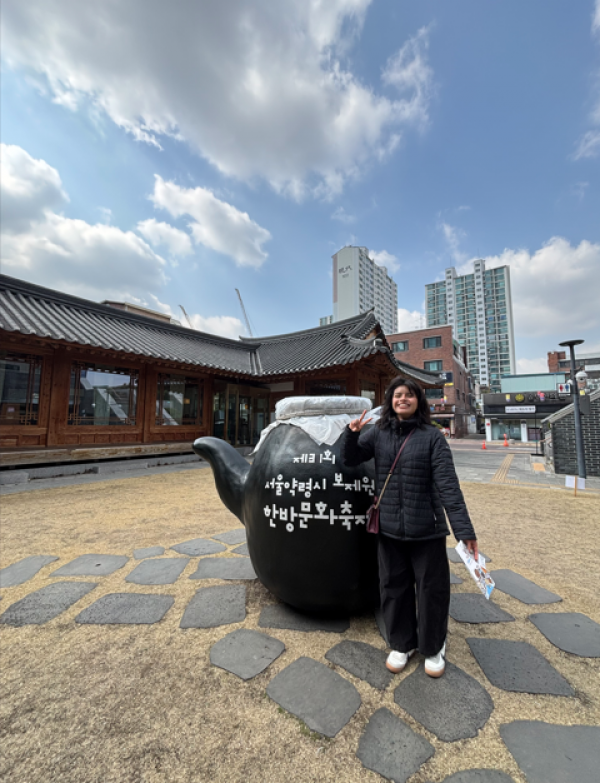
During my visit to the Seoul K-Medi Center and the Seoul Yangnyeongsi Herb Medicine Museum, I initially thought these spaces would share a layout similar to the Museum of Natural History in New York City. Instead, both locations felt much more interactive and modern than I expected. The Seoul K-Medi Center is located where Bojewon previously stood. During the Joseon Period, Bojewon was a clinic that offered free medicine and treatment to locals, and its practices are still visible today. In the K-Medi Center, the preserved cultural space uses foot baths, medicine, and food experiences to immerse visitors in its ancient practices. At the Seoul Yangnyeongsi Herb Medicine Museum, Hanbang was presented through digital exhibits, AI-generated visualizations, and immersive recreations of historical practices.

As I explored the museum, the exhibit that grabbed my attention was “Bojewon Through AI Art,” which used AI-generated interpretations of historical paintings and written records to recreate scenes from everyday life in ancient Korea. This technology made these practices feel immersive and accessible instead of outdated. Before this, I often viewed technology and traditional medicine as opposite sides of a line. That exhibit changed my assumption. It showed how modern tools can keep old knowledge legible and shareable by translating it into forms people can engage with. Another exhibit, “Healing at the Fingertips, Care in Everyday Life,” made the philosophy even clearer. The focus wasn’t on attacking a single symptom in isolation. Healing was described as helping someone return to ordinary life with renewed strength. This idea connects to the importance placed on sleep, nutrition, and the environment. In the “Harmony of Food,” exhibition, visitors are introduced to specific foods that support particular imbalances in the body, a way of thinking that ties daily routines directly to care. The museum wasn’t only about history. For instance, there was a section on healthcare careers, plus interactive simulations around nutrition and lifestyle. It wasn’t just telling visitors where oriental herbal medicine came from; it was showing how it might continue to grow and change.

As I walked through the Seoul Yangnyeongsi Market area, I recognized many of the herbs and ingredients I had just seen in the museum, now available in nearby shops and tea spots. In the tea houses around Yangnyeongsi, the spaces encouraged individuals to slow down. Natural light glowed through glass windows, soft instrumental music filled the room, and the overall atmosphere felt designed to enable a calming environment. Menus listed antioxidant teas and included general purposes and benefits, written in both Korean and English to be more foreigner-friendly.

Walking up the hills of Bukchon Hanok Village, I explored local ceramic businesses and tea shops on my way to Doho Healing Oasis. Doho’s philosophy comes from Hanja characters, with “Do” meaning to guide and “Ho” meaning to weave together. During my consultation, one of the physicians asked me to stick out my tongue before checking my pulse by feeling my wrist and hand. Without me explaining much, she described patterns connected to stress, circulation, and energy. During our discussion, she stated that Chinese, Japanese, and Korean traditional medicine were no longer as popular due to the expansion of commercial herbal food and natural wellness markets. In many Western healthcare settings, diagnosis depends heavily on scans, imaging, or long explanations of symptoms. At Doho, observation seemed just as important as explaining symptoms. During the consultation, the physician described the body as a “message stream” that ties spirituality and nature within our understanding of health.

Sasang constitutional medicine is the most unique theory in Traditional Korean Medicine. It classifies people into four constitutional types based on an individual's psychological and physical traits. The susceptibility to diseases and drug responses varies depending on an individual's constitution (Neurological Research, 2007). This concept was present in Doho, as my physician explained the physical effects chronic stress can have on the body through the Hypothalamic-Pituitary-Adrenal (HPA) axis. Her explanation of the HPA axis allowed me to connect her advice to my own personal experience managing my autoimmune disorder, and see how applying traditional medicine and new lifestyle routines can help ease symptoms or prevent flare-ups. Her discussion on energy flow and nature was unfamiliar, as it blended scientific ideas with philosophical framing. Noticing my confusion, the physician clarified her statement by placing it in the context of modern habits, hours sitting, constant screens, and stress ignored until the body forces attention. These ideas also contribute to public health conversations surrounding integrative medicine and long-term wellness (World Health Organization, 2023).
Being someone who primarily interacts with patients in a hospital setting, I often viewed healthcare and traditional medicine as distinct matters that struggled to merge. Mainstream healthcare in the United States was primarily composed of drug treatments and clinical interventions. In Seoul, I encountered approaches that went beyond standard clinical practice norms as physicians personalize their time with patients and focus on the influence nutrition, routines, and the environment can have on a patient's health. Seeing herbal medicine remain so visible throughout the Yangnyeongsi area also made these practices feel much more present and ordinary than I expected. More than anything, the trip highlighted the need for personalized care and the incorporation of modern and traditional medicine in our daily lives.
References
Han, S. Y., Kim, H. Y., Lim, J.-H., Hong, C. J., Kwon, Y.-K., Kim, H., Yang, G. Y., & Chae, H. (2016). The past, present, and future of traditional medicine education in Korea. Integrative Medicine Research, 5(2), 73–82. https://doi.org/10.1016/j.imr.2016.03.003 (pubmed.ncbi.nlm.nih.gov)
Leem, K.-H., & Park, H.-K. (2007). Traditional Korean medicine: Now and the future. Neurological Research, 29(sup1), 3–4. https://doi.org/10.1179/016164107X172392 (tandfonline.com)
Kim, M., Han, H.-R., Kim, K. B., & Duong, D. N., The use of traditional and Western medicine among Korean American elderly - Journal of Community Health. SpringerLink. https://link.springer.com/article/10.1023/A:1014509200352/
World Health Organization. (n.d.). Global strategies. World Health Organization. https://www.who.int/teams/integrated-health-services/traditional-complementary-and-integrative-medicine/global-strategies/
Whidden, L. (2023, June 5). Ecuador’s integration of traditional medicine and modern healthcare system. The Cornell Healthca. https://www.cornellhealthcarereview.org/post/ecuador-s-integration-of-traditional-medicine-and-modern-healthcare-system/
World Health Organization. (n.d.-b). Traditional Medicine has a long history of contributing to conventional medicine and continues to hold promise. World Health Organization. https://www.who.int/news-room/feature-stories/detail/traditional-medicine-has-a-long-history-of-contributing-to-conventional-medicine-and-continues-to-hold-promise
Author(s):
