
From High-Tech to High-Utility: How South Korea’s Innovation Infrastructure Affects Day-to-Day Lives.
Published 06/03/2026 in Scholar Travel Stipend
Written
by Murat Khidoyatov |
06/03/2026
Seoul has gradually become a leader in municipal infrastructure and industrial automation. This can be seen not only in pinpointed technical innovation but also in how accessible and integrated these industries are in everyday life and around the world.
Wherever you go, everything includes a digital touchpoint, contactless transit gate, automated checkout hub, and an IT-integrated network node. The authentic culture constantly surrounds itself with new developments in automation and digital platforms, which is reflected in the endless public advertisement, the growth of tech companies and infrastructures, civil robots, and, most importantly, the people’s interest in maintaining a highly efficient lifestyle.
By this point, Korea’s engineering and innovations are deeply embedded in the history and culture of modern South Korea. Before visiting Seoul, I remember constantly seeing advanced technology and automated systems incorporated into modern and historical K-dramas. From the first mass-production factories during the famous “four Asian tigers” era, to the sleek screens appearing on seemingly every device at one point, technology has clearly played a major role throughout both Korean history and modern culture.
At the National Museum of Korea in Seoul, I spent significant time analyzing their autonomous, AI-driven guide robots, which are widespread and common practice across South Korea’s public spaces. These robots are specifically designed to enhance navigation and eliminate the language barriers that frequently arise between locals and international visitors.

Caption: Navigation Robots
Equipped with natural language processing models, these robots are inherently programmed to speak and understand several languages simultaneously, including English, Korean, Mandarin, Japanese, and Russian. They perform a cross-linguistic ability that a regular human employee alone could rarely match.
Furthermore, these machines feature face detection and proximity tracking systems. The moment a person approaches, the robot detects their presence, shifts its digital display eyes into welcoming heart shapes to build an instant connection, and opens a touch screen to help with any problems or questions. From personal experience, it was a great way to ensure that the integration of the new technology is more seamless and friendly. Furthermore, empirical research on social robotics in public spaces confirms that conversational guide robots significantly increase visitor engagement metrics and provide critical feedback and accessibility for diverse, multi-lingual populations (Kim et al, 2022)
However, you will encounter an advanced face detection system even before you set foot in Korea. During the pre-travel visa process, I was required to upload a digital photograph to the government's online entry portal. When I arrived at Seoul International Airport’s passport control, instead of traditional border control methods where customs agents manually inspect, scan, and flip through physical passports for every individual, the immigration checkpoint utilizes an advanced face detection system. Automated cameras scan the faces of all incoming visitors as they approach the barrier. The system then cross-references live biometrics against the pre-registered digital database, and thus allows travelers to clear the border securely in seconds instead of scanning individual passports. Aviation and transport logistics studies confirm that integrated biometrics, also known as “Smart Pass Framework,” allows for cutting passenger processing times by over 40% while enhancing international security protocol (Incheon International Airport Corp., 2023).
Another area where they successfully integrated a wide digital network into day-to-day life was through transportation, specifically the T-money program. T-money is originally a means to pay for the city-wide public transportation, including subway, buses, etc. However, you can also use your T-money card for regular purchases. T-money is everywhere, I mean, literally everywhere. Their contactless terminals dominated airports, corner streets, convenience stores, subway stations, and were sometimes even located only a couple of hundred meters away from each other. By linking a transport network, retail stores, and government services into a single transnational framework, this unified platform proves that digital systems can move far beyond convenience to serve as a core tool for urban resilience and economic efficiency (Oh & Chung, 2020).

Caption: T-money card used for subway fare
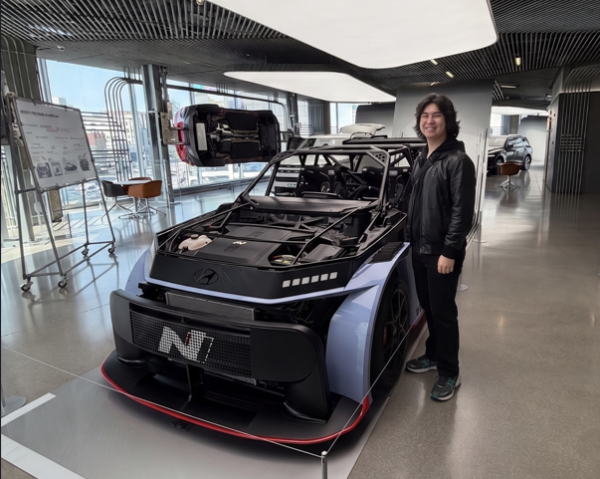
Looking into a transport system in Korea, one cannot pass the Korean’s famous automotive market, when brands like Hyundai dominate the domestic and international markets. What was interesting to note is that what is popular in the U.S in terms of vehicle innovation isn’t necessarily what is prioritized in Korea. Meanwhile brands like Tesla, Rivian, or Lucid that led the EV boom in the U.S, are barely making a scratch in the Korean EV market baseline. With recent restrictions on the global carbon chain, the demand for highly optimized production platforms has continued to grow. According to an industry report, the U.S currently has a limited range of automated processes that companies can utilize to build vehicles (McKinsey & Company, 2023). It is obvious, even on the surface level, that U.S. EV cars are too expensive, and the U.S. EV market needs true scalability and a deep understanding of the industrial supply chain. To observe this side of the innovation, I visited the Hyundai Motors division that displays a full history and values of Hyundai, to analyze how South Korea’s industrial sector engineers practical solutions for global challenges.
Korea’s automotive industry traces its legacy to the legendary Hyundai Pony. Introduced in the mid-1970s, the Pony was a monumental achievement - it was the nation’s first independently developed, mass-produced, and highly affordable passenger car. In post-war Korea, a personal car was considered an unattainable luxury for the vast majority of the population, which were limited in geographic and economic mobility. By purposefully designing a car optimized for mass assembly and the domestic automotive ecosystem, Hyundai did not just create a product; they catalyzed the domestic automotive ecosystem, ignited an industrial boom, and accelerated the rapid development of what is now one of the largest automotive industries in the world (Kim, 1997).
Carrying on this legacy to this day, I observed a fascinating strategic contrast between South Korean industrial design and Western manufacturing paradigms. While American companies tend to center their corporate identities on discrete, localized product innovations inside the vehicle, like proprietary software features, luxury cabin options, or niche stylistic traits, Hyundai’s macro-philosophy focuses specifically on the industrial and process-driven side of technology implementation. Instead of prioritizing high-margin cosmetic features, Hyundai directs its capital and engineering toward radically optimizing the manufacturing pipeline itself, focusing specifically on trying to reduce the manufacturing cost of batteries, cell packaging, and modular chassis assembly.
To achieve this, they incorporate an aggressive focus on advanced robotics technologies directly into their manufacturing environment. This is highlighted by their recent purchase of Boston Dynamics from Google. Even though Boston Dynamics is a famous company, almost every giant that has owned it, including Google, has failed at properly scaling it and making it a profitable business. In that regard, Hyundai was the first company that successfully managed to successfully implement the large-scale advanced humanoid robotics system into their manufacturing pipeline, as they aim to eliminate assembly bottlenecks and lower consumer expenses.
From this trip, I am still left in awe of all the advancements Korea has made in the fields of infrastructure, biometric technology, and industrial robotics. At the same time, I leave questioning whether blind technological acceleration is something we truly want to encourage, especially in a time where automated work and machine reliance continue to rise at such a rapid pace. True leadership and advancement in a complex world requires us to look past superficial novelty and fast progress, and instead focus our energy on building, supporting, and scaling systems that are genuinely high-utility, to ensure that technology serves as a tool and not as a threat.
References:
- Incheon International Airport Corporation. (2023). Implementation and operational efficiency of the facial recognition 'Smart Pass' system. IIAC Aviation Research Report, 14(2), 45-58
- Kim, L. (1997). Imitation to innovation: The dynamics of Korea's technological learning. Harvard Business Press.
- McKinsey & Company. (2023). Unlocking the future of electric vehicle manufacturing: Process optimization vs. product features. McKinsey Automotive Practice Insights.
- Oh, J., & Chung, S. (2020). The evolution of integrated contactless smart card systems in metropolitan transit networks: Lessons from Seoul's T-money framework. Transportation Research Part A: Policy and Practice, 132, 889-904.
- Kim, S., Lee, H., & Park, J. (2022). Evaluating human-robot interaction and multi-lingual accessibility of AI service robots in public cultural spaces. Journal of Smart Tourism and Innovation, 8(3), 112-125.
Author(s):
