
Beyond the Stadium: What Morocco and Mexico Reveal About the Legacy of Mega-Sporting Events
Published 09/15/2026 in Scholar Travel Stipend
Written
by Marisol León |
09/15/2026
At the 2026 Milken Global Conference, the panel “The Legacy Play: How Global Sport Shapes Cities, Economies, and Culture” posed an important question for governments competing to host global sporting events: What remains after spectators go home? The Africa Cup of Nations (officially AFCON 2025, although most of the tournament took place in January 2026) in Morocco and the 2026 FIFA World Cup in Mexico provide particularly revealing case studies.
I had the opportunity to experience both events firsthand—attending Morocco’s semifinal against Nigeria at Prince Moulay Abdellah Stadium in Rabat and the Mexico-England World Cup match at Estadio Azteca in Mexico City. The scale, enthusiasm, and pride surrounding both events were unforgettable. Yet traveling through Rabat and Casablanca and visiting Mexico City’s Bosque de Chapultepec made visible the broader infrastructure and public policy choices surrounding these events. Together, these experiences suggest that mega-sporting events can generate meaningful public value when governments leverage them to make lasting investments in local communities rather than focusing primarily on the successful staging of the event itself.
Morocco: World-Class Infrastructure Amid Demands for Basic Services
Morocco constructed or upgraded nine stadiums for the AFCON tournament while simultaneously accelerating major investments in airports, railways, roads, and urban and tourism infrastructure as part of its preparations for the 2030 FIFA World Cup.[1] At the Morocco-Nigeria semifinal I attended on January 14, 2026, the result of this investment was tangible. Prince Moulay Abdellah Stadium in Rabat made the scale and ambition of Morocco’s preparations for international sporting events immediately apparent. Morocco ultimately defeated Nigeria on penalties before advancing to the final, and the tournament became a demonstration of Morocco’s capacity to stage international events at an exceptionally high level. CAF described the Morocco-Nigeria semifinal as a clash between “two continental heavyweights” expected to “draw attention worldwide.”[2] Post tournament assessments similarly praised Morocco’s facilities and technological investments, with BBC Sport reporting that the tournament’s stadium technology impressed visiting media and that Morocco had established a new standard for AFCON hosting.[3]

Morocco v. Nigeria, AFCON semifinal, Rabat.
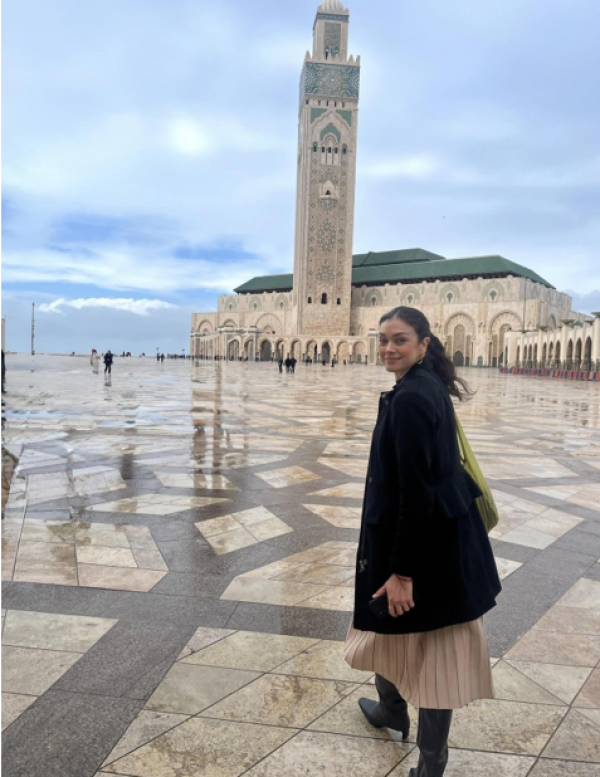
The benefits were also visible beyond the stadium. Traveling between Rabat and Casablanca and visiting Casablanca’s Hassan II Mosque, the monumental mosque overlooking the Atlantic, underscored the importance of Morocco’s transportation and tourism infrastructure. Investments made in preparation for AFCON and the 2030 World Cup are intended to facilitate this kind of travel: connecting airports, rail systems, cities, sporting venues, and tourism destinations. Morocco plans infrastructure spending equivalent to an estimated 11.9 percent of its 2024 GDP between 2024 and 2030, including rail, airports, roads, stadiums, and urban and tourism infrastructure.[4] From a Milken Institute perspective, this is the strongest argument for mega-sporting events: strategically deployed capital can accelerate infrastructure that increases connectivity and economic productivity long after a tournament ends.
Yet Morocco also demonstrates why improvements in infrastructure alone do not leave behind an inclusive legacy. In the months preceding AFCON, the Gen Z 212 movement (a leaderless collective named after Morocco’s dialing code) organized protests demanding improvements in healthcare and education while expressing broader frustrations over unemployment, inequality, and government priorities.[5] One slogan highlighted conflict over public priorities: “We want hospitals, not stadiums.” Those criticisms continued during the tournament. Reporting during AFCON highlighted this tension: Morocco had mobilized more than €880 million between 2023 and 2025 to upgrade six stadiums, while youth unemployment stood at 35.8 percent and the country had only 7.3 doctors per 10,000 residents.[6] Thus, the impressive stadium I experienced in Rabat can be interpreted in two ways simultaneously: as evidence of Morocco’s remarkable capacity to mobilize investment and execute complex mega-sporting projects, and as the physical manifestation of the opportunity-cost at the heart of the protests and demonstrations.
Mexico City: The Promise of Social Investment
Mexico presents a somewhat different model. Attending Mexico versus England in the majestic Estadio Azteca in Mexico City similarly demonstrated fútbol’s extraordinary capacity to create collective identity and attract international visitors.

Mexico v. England, Mexico City.
Yet one of my most instructive experiences in Mexico City occurred far from the stadium. While visiting the Bosque de Chapultepec, I spoke with Mexico City government employees distributing World Cup-branded pamphlets titled What to Do in the Event of Violence Against Women? In addition to displaying the logos of the Mexico City government and its “La Pelota Vuelve a Casa” World Cup initiative, the pamphlet defines sexual, physical, psychological, symbolic, and gender-based violence and directs women to emergency and psychological services. It also provides information about post-exposure prophylaxis following sexual assault and lists public hospitals where services can be obtained free of charge. Most strikingly, the pamphlet explicitly connects the intervention to the mega-sporting event: “Enjoying the biggest event of the year without fear is our right.”

World Cup gender-violence pamphlet obtained in Bosque de Chapultepec, Mexico City.
This small encounter offers an important example of what an inclusive sporting legacy can mean. Rather than defining World Cup preparation exclusively as stadium renovation or visitor accommodation, Mexico City used the enormous public attention generated by the World Cup to disseminate information about gender violence and connect residents and visitors with public services. That approach was part of a broader effort: Mexico’s Secretaría de las Mujeres described initiatives connected to fútbol as opportunities to combat gender stereotypes, promote women’s leadership, and encourage women’s use of public space.[7] More than 40,000 Mexico City public employees ultimately participated in World Cup operations involving mobility, security, logistics, and sanitation.[8]

Yet Mexico’s experience also exposes the mega-sporting event opportunity-cost question. Residents and merchants from communities surrounding Estadio Azteca protested that World Cup preparations were contributing to displacement, loss of livelihoods, housing pressures, water shortages, privatization, and gentrification.[9] In effect, a government can distribute violence-prevention materials in the Bosque de Chapultepec while residents elsewhere in the same city reasonably ask whether the tournament has made their neighborhoods more expensive or less secure. In Mexico City, I saw both realities coexist.
From Economic Impact to Shared Prosperity
The comparison therefore suggests that the wrong question is simply whether mega-sporting events “benefit” host countries. They almost certainly produce some benefits. The more important question, and the one most closely aligned with the Milken Family Foundation and Milken Institute’s emphasis on shared prosperity, is who captures those benefits, who bears the costs, and whether public investments retain value once the event ends.
Morocco shows the extraordinary infrastructure-building capacity that a global sporting deadline can unlock, but also the political danger of world-class facilities existing alongside inadequate basic services. Mexico shows how a sporting event can become a vehicle for less visible forms of social investment, including public safety and gender-violence prevention, while simultaneously demonstrating how tourism and redevelopment can impose concentrated costs on already vulnerable communities.
My experiences at both tournaments reinforced this tension. The crowds in Rabat and Mexico City demonstrated something economic-impact studies struggle to quantify: sporting events can generate genuine pride, collective experience, and cultural exchange. My experiences outside the stadiums, from Casablanca’s Hassan II Mosque to an unexpected conversation with public workers in Chapultepec, also showed how far a tournament’s effects extend beyond the field.
That suggests a more demanding definition of “legacy.” Success should not be measured primarily by attendance, increased tourism, television audiences, or whether stadium construction was completed on time. Host governments should establish measurable commitments before bidding: permanent transportation improvements, local hiring and procurement targets, affordable-housing protections, safeguards against displacement, public-health investments, and mechanisms ensuring that new infrastructure remains accessible to residents. The pamphlet I received in the Bosque de Chapultepec provides a modest but instructive example. Its value was not that it made the World Cup more impressive. Its potential value was that it used the World Cup to connect people to resources that matter—whether or not a match is being played.
The experiences of Morocco and Mexico demonstrate that mega-sporting events do not inherently produce shared prosperity. Rather, they create a rare opportunity to mobilize substantial capital, political attention, and institutional capacity. Whether that investment produces an inclusive and lasting legacy ultimately depends on how governments deploy those resources and whose needs they prioritize.
[1] Confédération Africaine de Football. “Zineb Benmoussa at the Heart of the Stadium Modernisation Project for the TotalEnergies CAF AFCON 2025.” CAFOnline.com, 11 Dec. 2025, https://www.cafonline.com/afcon2025/news/zineb-benmoussa-at-the-heart-of-the-stadium-modernisation-project-for-the-totalenergies-caf-afcon-2025/ . Accessed 5 Sept. 2026; International Monetary Fund. “Morocco: 2026 Article IV Consultation and Review Under the Flexible Credit Line Arrangement—Press Release; Staff Report; and Statement by the Executive Director for Morocco.” IMF Staff Country Reports, vol. 2026, no. 72, 20 Mar. 2026, https://www.elibrary.imf.org/view/journals/002/2026/072/article-A001-en.xml/ . Accessed 5 Sept. 2026
[2] Confédération Africaine de Football. “AFCON 2025: Morocco vs Nigeria—A Heavyweight Semi-Final Charged with Dreams, Ambition and Pressure.” CAFOnline.com, 14 Jan. 2026, https://www.cafonline.com/afcon2025/news/afcon-2025-morocco-vs-nigeria-a-heavyweight-semi-final-charged-with-dreams-ambition-and-pressure/ . Accessed 5 Sept. 2026.
[3] BBC Sport. “AFCON 2025: What We Learned from Finals in Morocco.” BBC Sport, 21 Jan. 2026, https://www.bbc.com/sport/football/articles/c620nnj0z8lo/ . Accessed 5 Sept. 2026
[4] Taheri Sanjani, Marzie, Kassia Antoine, and Pedro C. Rodriguez. “Macroeconomic Impact of Accelerating Public Infrastructure Investments in Morocco.” Selected Issues Papers, vol. 2026/026, International Monetary Fund, 6 Apr. 2026, https://www.imf.org/en/publications/selected-issues-papers/issues/2026/04/06/macroeconomic-impact-of-accelerating-public-infrastructure-investments-in-morocco-575239/ . Accessed 5 Sept. 2026.
[5] Metz, Sam, and Akram Oubachir. “Gen Z Protests Against Corruption and Inequality Are Shaking Morocco. Here’s What to Know.” Associated Press, 17 Oct. 2025, https://apnews.com/article/morocco-gen-z-protests-king-explainer-b6bc8c7bbee375e0896d75f5c5a085fb/ . Accessed 5 Sept. 2026.
[6] Aybar Laafou, Soraya. “Inversiones millonarias para una Copa de África en Marruecos, que entretiene a la generación Z, pero ignora sus demandas.” El País, 15 Jan. 2026, https://elpais.com/planeta-futuro/2026-01-16/una-sanidad-rota-frente-a-estadios-nuevos-la-copa-de-africa-que-no-resuelve-las-demandas-de-la-generacion-z-en-marruecos.html/ . Accessed 5 Sept. 2026.
[7] Secretaría de las Mujeres. “Con acciones integrales, Secretaría de las Mujeres impulsa participación de las mujeres en el futbol.” Gobierno de México, 12 June 2026, https://www.gob.mx/mujeres/prensa/con-acciones-integrales-secretaria-de-las-mujeres-impulsa-participacion-de-las-mujeres-en-el-futbol/ . Accessed 5 Sept. 2026.
[8] N+. “Entrega Gobierno de la CDMX la Medalla ‘La Pelota Vuelve a Casa’ a Miles de Trabajadores.” N+, 20 July 2026, https://www.nmas.com.mx/ciudad-de-mexico/sociedad/entrega-gobierno-de-la-cdmx-la-medalla-la-pelota-vuelve-a-casa-a-miles-de-trabajadores/ . Accessed 5 Sept. 2026.
[9] Quintero, Josefina. “La Copa del Mundo provoca ‘despojo y desplazamiento’, señalan vecinos.” La Jornada, 24 Jan. 2026, p. 25, https://www.jornada.com.mx/2026/01/24/capital/025n2cap/ . Accessed 5 Sept. 2026.
Author(s):
