
An Environmental Look at Taiwan’s High Speed Rail
Published 03/20/2026 in Scholar Travel Stipend
Written
by Waly-Meissa Ndiaye |
03/20/2026
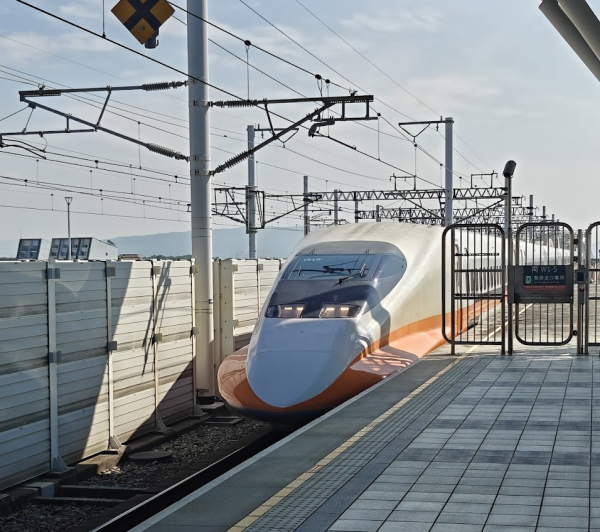
High-speed rail projects have often been viewed as environmentally beneficial and an innovative form of mass transit. In particular, they serve as an effective way of limiting carbon emissions, the importance of which is ever-pressing, given the impact climate change has had and will continue to have on our planet in the coming years. These infrastructure projects can play a major role in improving the long-term environmental health of local communities, one of the primary focuses of the Milken Institute.
Many countries have made efforts in recent decades to build new and extensive high-speed rail systems, yet the United States has unfortunately made limited progress in this regard. Still, many advocates continue to push for progress in expanding American commercial passenger rail. One nation that has made significant investments in expanding its passenger rail networks is Taiwan, which, in 2007, first opened its high-speed rail network. This system now spans about 350 km, running from Nangang in the north of the country to Kaohsiung (Zuoying) in the south (Taiwan High Speed Rail Museum).
So, in December 2025, I journeyed to Taiwan to take a closer look at their high-speed rail network. During my time in the country, I took the system from Taipei to Kaohsiung and visited the official museum dedicated to the development and history of the infrastructure. Through this, I aimed to gain a first-hand perspective on how Taiwan's relatively new high-speed rail system functions and to see how environmental lessons learned from their projects could serve as an example and potential inspiration to American high-speed rail efforts.

For a high-speed rail system, or any public transit system for that matter, to have environmental benefits, it has to be used. An empty system won't yield many positives if people still choose to commute or travel primarily by motor vehicle. Given this, I first looked to see what region in the U.S. could serve as a comparable proxy for Taiwan’s system.
Taiwan is a very densely populated country, significantly more so than the United States as a whole. However, certain regions of the United States, such as the Northeastern/Mid-Atlantic, have a high density that serves as a useful point of comparison. The 2021 Census designated part of this region as a “Megalopolis,” covering areas spanning Boston, New York City, Philadelphia, Baltimore, and the District of Columbia, with a population of roughly 50 million people (Megalopolis – Census 2021). Conveniently, this region is served by the Northeast Corridor, Amtrak’s most popular line in the United States. With 12,018,536 rides in the financial year 2025, a 11.3% increase from 2024, this line is also serviced by Acela, one of the few higher-speed options in the United States, hosting 3,153,621 riders of its own after a 2.6% year-to-year decrease in usage (Amtrak FY25 Ridership).
The area served by Taiwan’s high-speed rail, meanwhile, covers a large majority of Taiwan’s population of 23 million. But when we look at ridership, Taiwan’s system is significantly more popular, especially when accounting for population differences, with more than 80 million rides over the same months as Amtrak’s 2025 financial year (Taiwan HSR Transportation Ridership). This shows that the northeast American rail system has substantial room to grow.
Regarding how Taiwan’s high-speed rail has performed environmentally, in 2024, Taiwan’s system was able to decrease carbon emissions by 1,108,149 metric tons, which would have otherwise come from individuals using motor vehicles for intercity travel. In terms of carbon uptake through plant absorption, it would require upwards of 2,800 Da-an Parks, a 60-acre park in the city of Taipei, to achieve a similar effect (Taiwan HSR Energy and Waste Management). These results aren’t one-off, though year-to-year outcomes vary, especially due to the pandemic. In addition, the transit company has continued to improve efficiency and has yielded thousands of additional metric tons of carbon reduction, alongside thousands of megawatts in electricity savings year-to-year.
Building the infrastructure for such systems has its carbon costs, however, and not all systems are created equal. According to a study by the International Union of Railways, the development of Taiwan’s high-speed rail system was the most carbon-intensive of several assessed in terms of construction-related emissions, compared to systems such as France’s LGV (Carbon Footprint of High Speed Rail, pg. 24). This is due to the many bridges, tunnels, and viaducts used to create the system, particularly around the capital, Taipei. Still, at a cost of just over 55,000 metric tons of CO₂ per year of construction, the system will save a significant amount of carbon emissions over the at least 60-year lifespan of its major civil engineering components (Carbon Footprint of High Speed Rail, pg. 22/26 & Taiwan HSR Energy and Waste Management).
The environmental impacts and considerations of Taiwan’s system weren’t limited to carbon emissions and electrical savings, and this was something I was able to learn more about at Taoyuan City’s Taiwan High Speed Rail Museum. During the development of Taiwan’s HSR, extensive thought was given to environmental and ecosystem preservation, including major planning considerations to support the conservation of different plant and animal species. In addition, vibration impacts were addressed in exposed sections of the system near residential areas, with engineers using different track technologies (LVT tracks) to reduce this form of environmental disturbance.

Some of the takeaways from my time learning about Taiwan’s rail system were that, with increased ridership and frequency, an improved Northeast Corridor high-speed rail system could hold strong potential. Given that Acela already exists, a new high-speed rail system on the Northeast Corridor could build off existing infrastructure rather than having to start from scratch, thereby incurring lower carbon emission construction costs. Ongoing plans are already working toward this through the NextGen Acela project, albeit at slower rail speeds than Taiwan’s network (NextGen Acela Fleet). The environmental conservation strategies seen in Taiwan’s project were also something I felt could be applied to future American rail projects, allowing the environmental benefits in carbon reduction to be paired with ecosystem preservation efforts. Given that some of the cities along the Northeast Corridor already have their own carbon emission reduction goals, a route running through them may further support and advance those missions, even though the track toward full construction of such a system may take a long time.
References:
Taiwan High Speed Rail Museum: https://tdiscovery.thsrc.com.tw/index_en.html/
Megalopolis - Census 2021: https://www.census.gov/content/dam/Census/library/visualizations/2021/demo/megalopolis.pdf/
Amtrak FY25 Ridership: https://media.amtrak.com/wp-content/uploads/2025/11/FY25-Year-End-Ridership-Fact-Sheet.pdf/
Taiwan HSR Transportation Ridership: https://en.thsrc.com.tw/corp/9571df11-8524-4935-8a46-0d5a72e6bc7c/
Taiwan HSR Energy and Waste Management: https://en.thsrc.com.tw/corp/79bcc3f1-f893-406d-a56b-39279726ed35#:~:text=The%20original %20annual%20carbon%20savings,building%20materials%20and%20air%20conditioning/
Carbon Footprint of High Speed Rail: https://railroads.dot.gov/sites/fra.dot.gov/files/fra_net/15009/Carbon%20Footprint%20of%20Hig h-Speed%20Rail%20UIC%202011.pdf/
NextGen Acela Fleet: https://www.amtrak.com/about-amtrak/future-of-rail/next-generation-acela.html/
Author(s):
